Search This Blog

Translate

Wednesday, December 26, 2012

Week 52 of Abundant Genealogy

Week 52: Personal Genealogy Website. For which private genealogy website are you most grateful? Who runs the site? How has it helped your family history research? Share the link to the site as well as its highlights as a way to say thanks to those behind the scenes.

The end of this writing prompt series has once again asked a question on a really thought provoking topic.  There are so many good personal websites out there, some that I use on a daily basis; it is like trying to choose a favorite flavor of chocolate cake!  For the purpose of this prompt I would like to highlight Lynn Palmero’s site, The Armchair Genealogist. 

Her main goal is to help people find their family history on the internet by giving you the tools you need to research and then write about them.  Last spring I participated in her family history writing challenge and even though I didn’t complete what I set out to write, I learned so much about my own writing style.  She opened the door a bit more for me to really begin to investigate my future as a “real” writer. 

Lynn has many tabs on her page to help you find your way and broaden yourself in your family history journey.  If you are a beginner, there is a beginner tab to get your started.  Looking for fellow writers to talk to?  Check out her forum for family history writers.  Her blog is always informative, up to date, educational, and at times good fun to read. 

I hope you enjoy it as much as I do!

Saturday, December 22, 2012

Heraldic Primer Part 4

This is the fourth part in a series on Heraldry. You can find parts 1, 2, and 3 on this blog under the heraldry label.  It is my way of giving genealogists a basic over view of what they are looking at when confronted with heraldic items in their search for family.  In this section I will cover common postures for sea creatures, insects, and reptiles.  You never know when you will find words for a heraldic achievement and not pictures.

As in four-legged creatures these categories also have standard postures associated with specific creatures and commonly seen animals as well.  For instance the dolphin and the lucy (the traditional name for a pike) are usually shown upright or swimming.  While reptiles are not common in heraldry, serpents are and frequently they are shown tied in knots or twisted around a staff.  In the case of insects, bees are very popular as a symbol of industry and are usually seen from the top with their wings spread. 

Below you will find the postures and more detailed explanations for them under each fauna category.  You will notice that in some cases there are specific words for specific creatures defining their posture.  These terms only define them and no other creature in their category.  Just like “pride” is used to define a peacock showing its feathers from the avian category.

Water Creatures
If it swims in fresh or sea water you may find it in heraldry.  While the dolphin is one of the more common animals you will see depicted there are many others as well.  Whales and various other types of fish are popular.  Crustaceans such as lobsters, crabs, and escallops can be seen on arms and you may also find a kraken (squid) or an octopus. 
Posture
Definition
Example
Embowed
Body curving inward on itself
 
Embowed-counterembowed
An “S” shaped curve to the body mainly seen in dolphins

Haurient
Body in pale, the head to the top or chief

Naiant
Body in fess, the head to the right or dexter of the arms
Uriant
Body in pale, the head to the bottom or base


 Insects and Reptiles
This category is the least common of creatures seen in heraldry.  Serpents, or snakes, are seen frequently to represent medicine when entwined around a rod or staff.  Reptiles are seen in top down views typically on heraldry.  This posture is known as tergiant.  Insects without wings are also shown typically  in this top down posture and are labeled tergiant as well.  If an insect has wings, however, they are called volant and not tergiant.


Posture
Definition
Example
Erect
An upright or sitting position
 
Involved, Voluted, Encircled
Coiled to form a circle
Nowed
Tied in a knot

Bee volant


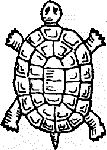
Turtle tergiant


Emmet, or ant, tergiant


In part five of the series I will cover the types of flora found in heraldry.


*Heraldic Clipart from “Free Heraldry Clipart Site”

Friday, December 21, 2012

More DNA Results!

Last week my husband’s DNA test from Ancestry came in.  I was so excited, jumping up and down excited.  However, I was good.  I waited until he got home to open the email and see the results.  It was hard, very hard.  We got a bit of a shock to say the least.  He is 96% British Isles and 4% unknown.  Wow, and I thought I was pretty homogenous with my DNA results at European (British Isles, Central European, and Eastern European).


The genealogy I have found for my husband makes this result believable.  He has ancestors from all over those islands: Ireland, Scotland, Wales, Cornwall, Jersey, and England.  However, he has 2 Germanic lines and I have a feeling are where the unknown bits come from.

Two of his 2nd great-grandmothers on his father’s side were of Northern European decent.  Augusta Jahnke (last name of step-father) was born in New York City to German immigrants.  Her mother, Maria Meier, was from Munster but I have not located where her father, Augustus Heinritz, was from.   The other grandmother, Annie Munsmann, was born in Connecticut to Danish immigrants Henry Munsmann and Caroline Anderson.  These two women are the only non-English ancestors that I have found in 400 years of family.

This week I began reaching out to potential cousins that are likely to be related to him.  There are quite a few in the 4th cousin range, but nothing closer than that.  One of these hints even had a tree match which makes things so much easier when corresponding with unknown people.    I am still slogging through the possible connections trying to identify other cousin matches that Ancestry may not know about.  His family had to be difficult with 2 name changes.  Sigh.

What are your thoughts?  Do you think that the 4% unknown could possibly be the genetic legacy of these two women?  Could it just be some “junk” DNA floating in there from an ancestor not identified?  Or am I completely off base here….

Thursday, December 20, 2012

Week 51 of Abundant Genealogy

Week 51: States and Provinces. What is your favorite state or province for genealogical research? Who is most generous with their records? How has this helped your family history research? Share with others your tips and tricks for researching in this location.

I have to admit my family’s move to Virginia put us in an excellent place to do research for family history.  Living in here within driving distance to The National Archives, The Library of Congress, The National Genealogical Society, The Daughters of the American Revolution Headquarters, and so many other historical and genealogical significant places means that there is never an excuse not to do research.  You can read about my discoveries in past posts on this blog.

Once you are in town you can spend every waking moment in research endeavors.  I have found the archivists, volunteers, librarians, and staff at these locations very helpful and friendly.  There isn’t a problem they won’t tackle and you can ask questions of them until you are blue in the face.  However, coming with a research plan and a goal in mind will make your visits more productive and worthwhile.  But, I am sure you all know that!  

My advice to you is that you need to think about what and how you pack.  Most of these institutions will not allow bags of any type into the research rooms.  This means you will need to store your belongings in lockers and carry your equipment into the research rooms and this can effect what you take. A little thought will need to be put into it to keep you happy and sane.  For instance loose papers are discouraged in the reading room at NARA.  In this case having your notes on a laptop or tablet would be most beneficial. 

Here’s to happy ancestor hunting in the Nation’s Capital!
 
photo credit: Klara Kim via photopin cc

Wednesday, December 19, 2012

It's Time for Blog Caroling!

Image from the Library of Congress
 
One of my favorite, but little sung, carols.  I hope you enjoy!  To see more Blog Carols make sure you check out the Footnote Maven’s Blog Caroling post.


Sung by the Mormon Tabernacle Choir on YouTube

 
English:  Bring a torch, Jeanette, Isabelle!

Bring a torch, to the stable run

Christ is born. Tell the folk of the village

Jesus is born and Mary's calling.

Ah! Ah! beautiful is the Mother!

Ah! Ah! beautiful is her child

Who is that, knocking on the door?

Who is it, knocking like that?

Open up, we've arranged on a platter

Lovely cakes that we have brought here

Knock! Knock! Knock! Open the door for us!

Knock! Knock! Knock! Let's celebrate!

It is wrong when the child is sleeping,

It is wrong to talk so loud.

Silence, now as you gather around,

Lest your noise should waken Jesus.

Hush! Hush! see how he slumbers;

Hush! Hush! see how fast he sleeps!

Softly now unto the stable,

Softly for a moment come!

Look and see how charming is Jesus,

Look at him there, His cheeks are rosy!

Hush! Hush! see how the Child is sleeping;

Hush! Hush! see how he smiles in dreams!


French:  Un flambeau, Jeanette, Isabelle --

Un flambeau! Courons au berceau!

C'est Jésus, bonnes gens du hameau.

Le Christ est né; Marie appelle!

Ah! Ah! Ah! Que la Mère est belle,

Ah! Ah! Ah! Que l'Enfant est beau!

Qui vient la, frappant de la porte?

Qui vient la, en frappant comme ça?

Ouvrez-donc, j'ai pose sur un plat

Des bons gateaux, qu'ici j'apporte

Toc! Toc! Toc! Ouvrons-nous la porte!

Toc! Toc! Toc! Faisons grand gala!

C'est un tort, quand l'Enfant sommeille,

C'est un tort de crier si fort.

Taisez-vous, l'un et l'autre, d'abord!

Au moindre bruit, Jésus s'éveille.

Chut! chut! chut! Il dort à merveille,

Chut! chut! chut! Voyez comme il dort!

Doucement, dans l'étable close,

Doucement, venez un moment!

Approchez! Que Jésus est charmant!

Comme il est blanc! Comme il est rose!

Do! Do! Do! Que l'Enfant repose!

Do! Do! Do! Qu'il rit en dormant!


Tuesday, December 18, 2012

New Software Release


For the past few weeks I have been assisting with the Beta testing of a new software program called Evidentia.  Some of you may have heard of it, if you haven’t, well, let me tell you about it. 

Evidentia is a program created by ed4becky, LLC and was released 17 December 2012 (yep that was yesterday).  They pride themselves in being a “Source Centric genealogy tool.”  Instead of looking at the person Evidentia looks at the source and the information it contains.  With this program you collect, in one place, all the pieces of evidence a single source holds. 

Once you have your sources and evidence, or assumptions, entered into the program Evidentia will create several different reports where you will see where the holes are, what flaws there may be in your logic, and lead you to figure out what else you need to research.  It will also give you a Genealogical Proof Report analyzing all the assumptions you have made about a specific fact, for instance your grandfathers birth date.  The Genealogical Proof Standard (GPS), as you may know, are the guidelines genealogists use to give credibility to their findings.  Following the 5 steps to the GPS will give your research the proof needed to feel confident in your findings, and Evidentia helps you with that. 

To help you along with the process of learning the software you can watch six videos available on YouTube. Within an hour I had several case studies up and running showing me how valid my proofs were and where I needed further work in my research.  Most important, this software is designed to enhance whatever program you currently use for genealogical research, not replace it.  Evidentia is available for Mac (OSX 10.7+) and PC (Windows XP, Vista, 7, 8) and best of all you can download a free 30 day trial before you purchase.  Also, for a limited time you can purchase Evidentia for $19.99 instead of $24.99.  In my opinion it is reasonably priced for software of this type.

So check it out, I don't think you will be dissapointed! I love my copy so much I became an affiliate.
 

Sunday, December 16, 2012

Week 50 of Abundant Genealogy

Week 50: Genealogy Database. Which individual database has been most helpful in your genealogy research and why? Is this database available for free or is it behind a subscription wall? What does this database include and how can it benefit other genealogy researchers?

There are so many databases bookmarked on my computer.  General Websites, lineage society records, archives, and various other places people may not think to look for their ancestors.  To be honest, there are hundreds of amazing databases out there.  I decided to pick one of the more obscure sites I like that maybe you don’t know about.

The Index to Early Bible Records is run by Debbie Duay, Ph.D, and is an ongoing project that provides an index to tens of thousands of pre-1800 family bible records.  It is part of an online lesson that teaches you how to research ancestors who may have been involved with the American Revolution.  Researching Your Patriot Ancestor teaches the basic research skills a person would need to help them with this quest, as well pointed you to places that you may not have looked for more information.

When you enter the index you will find information listed alphabetically by the husband’s last name.  Using the find function on your computer will be helpful at this point as there is not a search function embedded in the site.  The next columns list the husband’s first name, year range for the bible, wife’s maiden name, wife’s first name, where you can find the bible, and a title for the collection it is in.   Most of these bible records can be found online through the archives that hold them or Ancestry.com. 

Happy searching!  Maybe you will get lucky and find one of you ancestor in this index.  So far, I am still looking.
 
photo credit: mrmanc via photopin cc