Search This Blog

Translate

Showing posts with label genealogy books. Show all posts

Thursday, September 22, 2016

Book Review:  White Slave Children Trilogy by Richard Hayes Phillips, PhD

This year two more volumes in the Without Indentures series by Richard Hayes Phillips, PhD, published by the Genealogical Publishing Company, were released.  This little know index traces children who were transported to Colonial Maryland and Virginia from Europe and other colonies. Phillips new books add to his first book, Without Indentures: Index to White Slave Children in Colonial Court Records (Maryland and Virginia), which was published in 2013.  These new volumes concentrate on different records and specific county research.
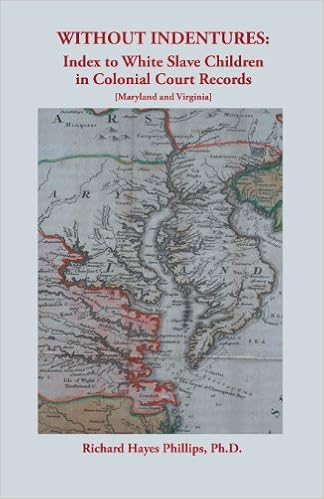
I have to admit that while I knew there were indentured children, I was unaware of the amount of underhanded deals which made hundreds of children essentially slaves.  Children who were taken from their homes in Colonial Massachusetts as well as in England who were lost in the records while they were sent to Maryland, Virginia, or the Caribbean.  Through extensive searching of extant documents Phillips has begun the process of finding these children who had, in many cases, simply disappeared from the family unit according to other records.

Each book gives you historical background for the various laws enacted as well as a guide to using the books.  Both of which are essential to read so you can understand the records which are discussed better.  I was fascinated by the historical background information contained in the text.  Through it I was able to I read about the laws which were enacted that lead to the trafficking of white children and then those that were later enacted to stop it. 
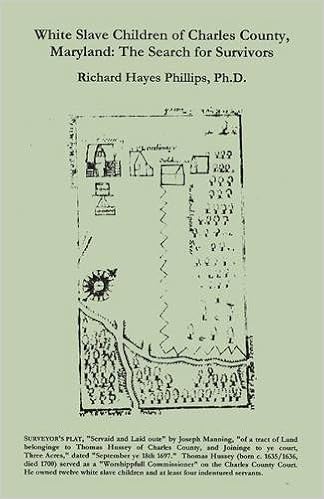
In White Slave Children of Charles County, Maryland: The Search for Survivors concentrates on records held  within this specific county. The small biographies in the beginning of the book were particularly informative.  Compiled from court records and other documents that have survived, these biographies covered not only some of the children but those who purchased them as well.  There is also a listing of “Dishonorable Mentions.” These were people who had a record of abusing their servants.  More than three quarters of the book however concerns the children slaves, or servants, who were found in records like orphan’s lists, deeds, estates, petitions for freedom, and runaways who were found.

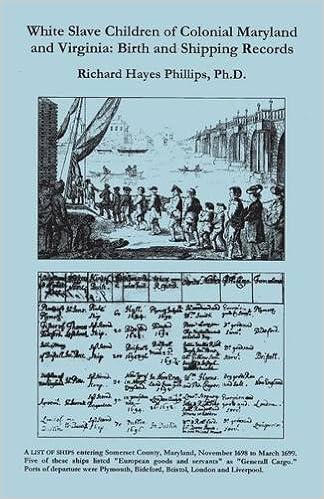
The second volume White Slave Children of Colonial Maryland and Virginia: Birth and Shipping Records concentrates on records from specific geographical areas.  Each chapter catalogs the birth and shipping records for those from an English County (such as Kent, Devon, or Essex), Country (like Ireland or Scotland), or another colony (Massachusetts).  Each entry lists all of the information uncovered for that person as well as where the information was found. 
Phillips admits that this is a subject in which more work still needs to be done.  This series of books could easily this could turn into a person’s life work as more records are discovered on this subject.  In fact, each county in Maryland and Virginia could be easily be covered through this research resulting in dozens of more books.
Truly a scholarly work, these books are essential for any library on colonial Maryland or Virginia research.  An excellent compendium of information to help discover those who are easily overlooked in typical research methodology.  I hope that you check them out if you do any research these areas.  Not only will you find excellent explanations on historical matters, but you may find a few surprise in the pages.

You can purchase these books though Amazon.com or Genealogical.com

Friday, October 30, 2015

Book Review: How to Use Evernote for Genealogy

I have a secret.  I am an Evernote drop out.  Yeah, yeah. I know. Bad on me. 

When it first came out I was actually all over it like white on rice, but I found it clunky and it didn’t do what I wanted it to do.  I briefly went back to try it again when my favorite note taking app, Penultimate, became sync-able to it.  It wasn’t long before I went back to my old ways though.  Tried and true, out of date, frustrating, but extremely comforting old ways of doing things.

Over the last few years Kerry Scott, who authored How to Use Evernote for Genealogy, has given me grief tried to convince me that I really need to check out Evernote again.  I listened to several of her webinars, learned how to do the web clipping feature, and did play around with some very cool features.  Still, I just couldn’t quite wrap my head around why everyone thought that this program was the best next thing to sliced bread.

I am a manual person.  No, let me rephrase that, I need hand holding to learn somethings.  I can be a real Luddite at times, and the thought of changing to something new can give me anxiety.  Usually I can overcome that with a tutorial and at times a workshop to help me with videos or demonstrations. 

That is why when I heard that Kerry had this book coming out I wanted to see what all the fuss was about.  Deep down I was secretly crossing my fingers that this would be the book to finally break me out of my Evernote using anxiety and come around to the digital age of genealogy record keeping.

I was not disappointed.

Even if you have never tried Evernote Kerry does an excellent job of holding your hand through all the steps, features, and program highlights.  Her quick wit and easy tone comes through to show you how set up your files with ease which made me feel a lot better about giving the program another try.

The book is also filled with images to help you along.  I am a very visual person so having pictures of the menus, drop down boxes, and the various screens you use in the program really helped when I pulled Evernote up on my computer.  For the first time in… a while.

I highly recommend this book for not only new users but also long time users of Evernote.  There are so many tips and resources in it that I am confident everyone will be able to learn something new.  For example she demonstrates how to use Evernote for keeping track of the genealogy related trips you take.  I don’t know about you but I take quite a few trips a year.  Conferences (local and far away), libraries, archives, cemeteries, family reunions, and so on.  I found the way she organized things in Evernote genius to keep her trips separated out and organized.  Actually, I am thinking about doing something similar to help keep track of my business expenses and income.


On that note, I am now trying to budget a few hours a week to transitioning to Evernote for my research.  It may take me a while but I am sure it will be well worth the time.

Tuesday, October 22, 2013

Reading and Digesting Complex Terms: Making a flow chart for MGP

When Tom Jones’s book Mastering Genealogical Proof came out earlier this year I snagged a copy early.  I even took it to FGS in August to get it signed by him and the one time I ran into him I had left it in the hotel room.  C’est la vie.  However, it has been one mighty tough book to get through.  Yes, I have found myself at times reading and re-reading the same passage multiple times trying to get what in the world he was trying to teach me. 

I stopped trying, and started writing it in my words.  That was the only way I was going to be able to digest the information and have it make sense to me in the end.  Read, interrupt, diagram, write, and repeat it all again.  Then I thought, you know, if I am having a bit of trouble others may be too.  So, here are some tricks for you to try on your own if you are having trouble getting through the book.  Oh and there will be another post on this.  I am only through chapter 5.  Chapters 6, 7, and 8 are in the works.

If you are a visual person like I am then I highly recommend creating a visual cheat sheet.  I broke out my colored pens and began making a flow chart of relationships with definitions for each section and term.  The new vocabulary was what I was tripped up on.  While I intuitively knew answers to the questions in the books (they just “felt” right in my gut) I had a hard time using the correct terms to explain and justify my answers.  Making those intuitive leaps that connect the dots so to speak just seemed to come naturally to me.  Trying to explain I knew it because of independent sources with primary information from a derivative work made my head hurt.

The first cheat I made was the bullet points for the GPS, or genealogical proof standard.  On the back of that card I placed the research and reasoning cycles.  My next card consisted of a summary on how to create a well worded research question.  Having these on one index card front and back was fine, until I needed to add to it.  Soon I found myself with an 11x14 piece of paper, folded in half, with many different colors and arrows on it.  Keeping it to this size will be a challenge, but you don’t want too much on a cheat sheet.

Below is the flow chart I created when my chicken scratch became too hard to read.  It has helped me use the correct terms when evaluating sources and information.  I hope you find it useful, or you can modify it to your needs.


 **Note: Yes, there are a few typos but this is my personal sheet and is a work in progress.  Sometimes I forget that Publisher does not have automatic spell check all the time...
The flow chart I created to help with the basics terms and ideas

Tuesday, September 3, 2013

Back to school today!

Today is the first day of school around here.  7 hours of child free bliss for me.  Not that I didn't almost breakdown, again, when my "babies" were leaving but a mom has to have some space too.

Today also starts the session of the Boston University Online Genealogical Research Program that I signed up for.  In a nutshell, I am really, really, nervous.  Most of you have told me I will be fine, and I am sure that I will be, but that overwhelming fear of the unknown is what is killing me.  Class starts at 10 am EST, just have to kill time until that happens.

Many of you spoke to me about blogging my experiences with the course.  I will do my best to give you my impression of the course; however I need to let everyone know about the Student Ethics Code that applies to what I can, or cannot, say here.

“Being an ethical genealogist means adhering to guidelines. Students should not create Internet profiles, trees, or post questions or answers in email lists or blogs concerning any course material, course assignments, or course case studies. This helps preserve the integrity of the course for all participants, current and future. Those violating this will be asked to remove or block the material immediately. Be aware that in some cases you are creating a permanent record which cannot be removed. Failure to observe this guideline may result in removal from the course. This policy is known as the "What goes on in Online Campus stays in Online Campus" student conduct clause.”

With this in mind I hope you all will understand why I do not post about the class in as much detail as some of you would like.  However, the textbooks for the course are available to everyone and I know many of you already have them.  I want to post my thoughts and conclusions after reading the various chapters from these books.  Feel free to post your thoughts on them as well.

The textbooks for this class, as listed on their website, are the following:

Board for Certification of Genealogists.
Orem, Utah: Ancestry, 2000.
ISBN: 0-916-489-92-2.

Elizabeth Shown Mills.
Citing History Sources from Artifacts to Cyberspace, 2nd Edition.
Baltimore: Genealogical Publishing Company, 2009.
ISBN-13: 978-0806318066

Elizabeth Shown Mills.
A Manual for Researchers, Writers, Editors, Lecturers, and Librarians.
Baltimore: Genealogical Publishing Company, 2001
ISBN-13: 978-0-8063-16482

Thomas W. Jones
Arlington: National Genealogical Society, 2013.
ISBN: 1935815075

Thankfully I purchased Tom Jones's book back in May when it first came out. The books are now on back order though Amazon and some students are scrambling for a copy. If you do not have it already I would pick it up. I am about halfway through it and there have been some real duh moments for me while reading it. In fact so many that I am seriously considering restarting my family tree program from scratch so I can redo it all correctly.


Have you read these books or participated in the BU program?  I would love to hear from you and know what you think!

Thursday, February 7, 2013

Genealogy Packages and Discoveries


The past couple of weeks have been a whirlwind of activity on the genealogy front around here.  My best day was last Monday when I received two items in the mail.  One, a letter from a cousin helping me research my Combs family line, and two, books from my parents.  Boy, it was like my birthday at the mailbox ripping open packages.  The kids, once again, thought mom had completely gone off her rocker.

In the letter there were two marriage certificates.  These certificates are needed to complete the DAR and the GSMD lineage society applications I am still working on.  She had to do battle with an unfriendly court clerk to get these, and I am very thankful that she put up with lady to further our research.  I am sure I am going to get to do that the next time I get back to Indiana.    Oh course, there were a couple of surprising elements to the marriage certificates.

First was the certificate for William Hall and Malira Price.  They are my 3rd great-grandparents who were married in Greene County Indiana on 25 February 1854.  It is a short form marriage register, so no good genealogical information for previous generations, but at least I have something for them.  From the form I see they received the license on the 23rd and had the marriage recorded on March 1st.  There isn’t any other information, not even a pastor’s name, but like I said I won’t be complaining.

Next was the certificate of their daughter Mary Margaret Hall.  She married Willis Franklin Combs in Greene County on 5 September 1877.  I stopped cold in my tracks, because something wasn’t adding up with that date.  I read, and re-read, and read a third time.  Then I went to look at my information on their oldest son Ira in my database.  Ira was born 29 October 1877.  Huh, that is interesting.  Now I wonder all sorts of things:  did they just wait a long time, was this "shot gun", was Ira his son?  I could go on and on.  Oh a puzzle and a family mystery!

The books were equally exciting, and proof that my parents spoil me.   A few weeks back I received two books through inter-library loan that have a significant amount of information on early colonial generations of my family.  I talked excitedly over the phone to my dad about it and he found a gently used copy online and bought them for me.  I jumped up and down with delight when I opened the package.  Tuesday I spent several hours reading and placing tabs in the book for each of the generations to make future look-ups easy.  It is going to take me a while to read and digest all the information presented, but boy is t going to be fun.  I particularly love that there are footnotes, sources, and a bibliography.  If you have any of the following lines check out this 2 volume book set.

It is going to be interesting to read about my ancestors who were from New Amsterdam.  I had no idea I had roots to Norway through one family.  Or that my family owned property in what is now Manhattan (60 acres…imagine what that would be worth today!).  Most unusual, “a husband selling his wife into Adultery”, I can guess what that meant.  I foresee several more days of night time reading in my future.

My most common recent ancestor with the author of this book is William Hayden.  William was born in Braintree, Massachusetts 5 October 1727 and died in Fayette County, Pennsylvania 18 July 1823.  He married Lydia Kierstede who was baptized 14 February 1725 in Staten Island, New York and died 1794-1795 in Hampshire County, Virginia.  This is the listing of their ancestor’s surnames that are covered in the book, all of whom are on my father’s side. 

Alden
Bass
Dey
photo credit: Bunches and Bits {Karina} via photopin cc
Duyts
Hayden
Holmes
Hyde
Jan
Jansen
Johnson
Laurenszen
Molenaar
Mullin
Neale
Pray
Pullen
Roelofs
Satyrs
Savil
Scott
Stillwell
Webb


Thursday, May 3, 2012

Week 18 of abundant genealogy

Week 18: Historical Books: This week we’re going to shine the spotlight on other historical books that benefit the genealogy field. Do you have a favorite book that falls in this category? What makes this book special to you? How can other genealogists benefit from its content?

I am an amature historian in addition to all the other things I like to do.  Reading about the past has always been interesting to me, and at times entertaining.  Picking just one book... wow, that is very hard.  I have bookcases of history themed books.  All time periods, many places and countries, various cultural endeavors, biographies,  and plus much more.  Putting on my genealogy hat for a moment I will do my best to narrow down the selection into what aids me with this field.

The three shelves of Irish themed books jump off at me first.  In college my husband took as one of his electives a course on Irish history.  I wasn't able to squeeze it into my schedule, but we kept the books.  Then, because we loved out trip to Ireland, and have always felt an affinity to the Irish, we kept picking up more books.  To name a few that have come in handy with Irish Genealogy:

The End of Hidden Ireland Rebellion, Famine, and Emigration.  By Robert James Scally

The Irish Experience a Concise History. By Thomas E. Hachey, Joseph M. Hernon Jr., and Lawrence J. McCaffrey.

Journal of Women's History Vol. 6 No. 4 / Vol. 7 No. 1 Special Double Issue on Irish Women.  Winter Spring 1995


Next on my list of must haves is my heraldry books.  Yes... I am a heraldry geek.  If you love looking at devices, but wonder what in the heck all those symbols mean check out An Heraldic Alphabet by J.P. Brooke-Little, Clarenceux King of Arms.  Fantastic book!!!

Those are my top picks.  Of course it was hard even to stop there.  Books are like my children; I want to show them all off!

Tuesday, April 24, 2012

My day at the fair

 
Last Wednesday and Thursday I attended NARA’s 8th Annual Genealogical Fair and I had a great time!  Everyone was very helpful, patient, and eager to share; perfect for a genealogical conference I would think.  As this was my first outing anywhere near a conference, on this subject, I was over the moon with it.

Wednesday was grey, drizzly, and cold which for an outdoor venue was not necessarily the best weather you could hope for.  Big name vendors and local area societies were present.  My friends and I walked past Ancestry, Fold3, and FamilySearch.  There was a large bank of terminals next to Ancestry and FamilySearch so that you could go out and start searching right then.

Down another aisle I stopped and talked to several of the local societies, the APG representative, and NGS.  The Loudon County Virginia Historical Society even took a note for me to give to the county archivist to help me find the documents I wanted on my 4th great-grandfather Edward Arvin.  (They are on their way to me now by the way!)  I enjoyed talking to the woman from the local APG chapter and I think it may be something I look into more in the future. 

We all stopped briefly to peruse the books section at the Foundation for the National Archives.  I left that day with three books:

·         Evidence! Citation and Analysis for theFamily Historian by Elizabeth Shown Mills

·         The Hidden Half of the Family: A Sourcebookfor Women’s Genealogy by Christina Kassabian Schaeffer

·         The Genealogy Tool Kit: Getting Started on Your Family History at the National Archives by John P. Deeban

The last book has been talked about recently on several blogs and in a press release from the Foundation for the National Archives.  It is a basic book, but there were step-by-step worksheets to take you through the records at the archives as well as how to research with original documents.  I am sure I will find it useful and a good book for the future.  Plus, I am a sucker for an autographed book.  The author was there and he signed my copy happily.

In the afternoon I introduced my friends to the reading room where the original documents are viewed at the archives.  I requested two more Civil War Pension Files and they had just as much, if not more, fun than I did looking through and analyzing the information.  We thought we had a good lead on a Civil war Ancestor for one of them, but when we started to read the file it was not her ancestor.  Bummer, but still fascinating as the widow had included newspaper clippings about her husband with her pension request. 

Thursday was a much nicer, and sunnier, day.  I took two classes.  In the morning I listened to a lecture on “Using the Congressional Serial Set for Genealogical Research” by Jeffery Hartley.  I had heard of the serial set but was not entirely sure as what it was.  Wow is all I have to say. That afternoon I attended “Treating the Sick and Wounded: Civil War Medical Records” by Nancy Wing.  My mother’s a doctor, I toyed with being a doctor, and I have a biology degree… do you think I could have passed this up?  It was fascinating and even got me thinking about how I need to have my mom write a guest post here.

The highlight of Thursday was meeting the author of Annie’sGhosts, Steve Luxenburg.  Of course I don’t have a paper copy of the book, it is on my iPad, but he kindly took a picture with me so I would have a remembrance of the day.  He chatted with me and my friends for a little bit and I have to say he was extreamly pleasant, very personable, and very tall.  You can listen to an interview with him  about this book from Lisa Louise Cooke at the Genealogy Gems Podcast.

The last part of the day was exploring the stacks at the research library.  I had not been in there before and I was not disappointed.  In the library are reference books, biographies, indexes, maps, and so much more.  All the books relate in some way to holding at the archives.  I just wandered the aisles reading titles, flipping through maps, and getting acquainted with everything.  It is a place that I will be going back to when I have a specific research plan.  That day, since the Revolutionary War was on my mind for some reason, I looked through indexes of soldiers for my ancestors.  Found most of them, and not  just names.  Most of the books had a description of the person, ranks, and short bio from the war.  Yes, I made copies.

Overall it was a very satisfying experience… and I have a lot of fling to do!

*Thanks to Barb for helping take pictures!

Monday, January 9, 2012

Book Review of Annie’s Ghosts

Last October I listened to one of my favorite podcasts, Genealogy Gems by Lisa Louise Cooke, and heard a fantastic interview with Steve Luxenberg on his novel Annie’s Ghosts.  Her two part interview (episodes 120 and 121) had me glued to the iPod and sparked more than a passing interest to find out what happened in the end.  Lucky for me I was given an iTunes gift card for an early Christmas present and I downloaded a copy first thing to read during our travels.

You can read a wonderful description of the book, by the author himself, on his website.  The press section of the website has some wonderful links to other articles that have been written about the book’s release and people featured in it.  There is a section there as well called behind the book filled with pictures and documents the author used in writing the book.  Personally, I wouldn’t read it until after you read the book; I feel it would be more meaningful then. 
So…my opinion of the book?  I loved it.  It was part history lesson, part detective novel all with an eye to find out who this mysterious Annie was.  In particular I enjoyed how he wound the background information into his narrative giving the reader the information they needed to understand where he would be taking them next in the story.  It was enlightening to read about the care of patients in mental hospitals and just how easy it was to have someone "locked away" less than a hundred years ago.  Reading the sections about escape during the holocaust were gut-wrenching; however it added poignant scenes that needed to be told for full understanding of the situations in the story.

He also gives me hope that I could one day write about all those secrets and mysteries I have yet to fully uncover in my family.