Search This Blog

Translate

Showing posts with label family stories. Show all posts

Monday, November 4, 2019

Just write it down: telling your family stories


Search the internet for how to write your family history and dozens of results will appear. Maybe you have toyed with the idea of writing and have never quite got around to it. Before you get completely turned off by this article, just know I am not going to browbeat you into anything. I will simply delve into why we have this need to write.

In 2015 The New York Public Library put together a list on why you should write your family history. [1] In it, the Library put forward 20 quotes from a variety of writers which I have now printed out and placed on my office wall. Why? Because these people “get” what it is to be a researcher and a family historian. I am sure you too.

For me documenting my life, my stories, my adventures are very therapeutic. I am putting down on paper items I want to remember, or I feel passionate about. It is my hope that in the future my scribbles and musings will enlighten a descendent, or fellow researcher, into the life of an ordinary person. Too often we only read about those who are famous in one way or another. There are not many journals from the common person showing what it was like to live during their era of history.

While writing the biographies of our ancestors is a goal for many genealogists I am always sad when I find that few of them take the time to write their own stories. I mean, honestly, who is the best person to write about your life? Your third great-grandchild or you? I hope you said you!

That being said, start small and simple as with any writing project. Many people feel comfortable simply keeping a journal and writing in it as important life events happen. Others like writing prompts to get them going. Whatever you choose, the important thing is to keep it going. For one, the more you write the better you will become. Two, the more you write the more it becomes second nature and it will feel off when you do not write!

In the sources listed below are several links to writing prompts to get you started. Of course, getting started is the hardest part for many people. I suggest you set aside a specific time each day or week where you can write. If you need a special pen or notebook, great. If you need to get away from the house and write at a special place, even better. Do what makes you feel comfortable and relax you enough to put pen to paper.

Now, get out there and leave a record for future generations of researchers. Just think how excited you would be to find these types of journals for any of your ancestors. So good luck and get writing!

More to Read:
Ales Honeysett, “Here’s Why Writing About Yourself is so Freaking Hard,” The Muse https://www.themuse.com/advice/heres-why-writing-about-yourself-is-so-freaking-hard
Carmen Nigro, “20 Reasons Why You Should Write Your Family History,” The New York Public Library, https://www.nypl.org/blog/2015/02/09/reasons-to-write-your-family-history
Emer McKeon, “Why You Should Consider Writing an Autobiography,” Bookstr https://www.bookstr.com/why-you-should-consider-writing-your-autobiography
James Hamblin, “The Power in Writing About Yourself,” The Atlantic https://www.theatlantic.com/health/archive/2014/12/ew-feelings/383475/
Michael Gonchar, “500 Prompts for Narrative and Personal Writing,” The New York Times https://learning.blogs.nytimes.com/2014/11/13/500-prompts-for-narrative-and-personal-writing/


[1] https://www.nypl.org/blog/2015/02/09/reasons-to-write-your-family-history

Saturday, October 21, 2017

Social history in your family history

If you have read many of my blog posts, here and elsewhere, you may remember me talking about how I love studying the social history aspect of genealogy.  For me it really breathes life into the people I am researching.  It is a way for me to connect to them.  To feel their plight.  Know what they lived through.  Read about what they saw.  Be jealous at the prices they paid!


While I think I know how to do social history research I am not confident enough to say I know everything about it.  By listening to others lecture on the subject and reading as much as I can I am hopeful some holes in my knowledge will fill in and learn new insights into this field of study.

According to the Merriam Webster online dictionary social history is defined as “history that concentrates upon the social, economic, and cultural institutions of a people.”  This definition refers to a group of people, but it very well could be the study of one person.  Often a case study is called the social history of a person.  I know how much we genealogists love a good case study!

One thing I think we should look at more as researchers are what the childhoods of our ancestors were like.  Looking back at my own family I do not know a lot about my ancestor’s childhoods.  A few stories from my great grandparents have made it to me but as for many of them they are a big black hole until they start creating records of their own.

I have thought about that more and more making me realize that it is a shame we don’t have more reliable resources on childhood through ages.  Especially to fill in the lives of those members of our extended families who did not make it to adult hood.

As the daughter of the doctor I tend to love learning about the history of the health industry.  You know disease, mortality, injuries and so forth.  If you have ever read a pension record, or a newspaper article for that matter, there are times that we need to educate ourselves on the names of common diseases used at the times our ancestors lived.  

Of course, the medical fields roll into a common human theme of abuse of drugs and alcohol.  If you think that drug and alcohol abuse are only a modern problem, think again.  It affected our ancestors in different ways, especially when it may have been your doctor getting you addicted, but there were still implications on the home and family.  A part of social history that was shameful for many families, but can demonstrate a familial link of dependence and addiction which seems almost inherited in some people.

On a brighter note have your ever thought about how technology effected the lives of your ancestors? You know, little inventions like the portable camera.  A little over 100 years ago Kodak created a smaller camera that now allowed people to take their own pictures.  It spread like wild fire.  Now nearly everyone has a camera (especially if they have a phone).  I sat and thought about how my recent ancestor’s way of documenting their lives changed. No pictures, to a few, to dozens, and now thousands of pictures a year.  Just imagine how that changed the way they felt about each other then and the way they could now remember special events.

If you are still not sure why you should consider studying social history, here are a few resources you should read about on why social history is an important field of study for genealogists.

·        Lisa Louis Cooke Genealogy Gems “Tell your Ancestor’s Story: Use Social History for Genealogy”  http://lisalouisecooke.com/2015/09/social-history-for-genealogy/
·        Gena Philibert Ortega “100 Social History Websites”
·        Katherine Scott Sturdevant Bringing Your Family History to Life Through Social History http://www.amazon.com/Bringing-Family-History-Through-Social/dp/1558705104

Friday, October 13, 2017

Writing Family Stories for Future Generations


One of these days…I am going to write a family history book.  Sound familiar? For me, the hardest part is figuring out which story I want to tell.  You might be stuck on which medium to use. No matter what the problem may be this post will give you a few ideas on how to get started on that project you have always wanted to complete.

For the purposes of this post I will assume that you have gathered your resources, organized them, and are ready to start.  You just need to pick the outlet.  Which, may be a harder choice than you realized.  Choosing the outlet for your work really depends on who your audience will be and what you want to do with it when you are done. 

Genealogical writing is in the vein of non-fiction essays or stories.  There are many books and websites where you can get guidance, templates, and advice on how to write in this vein.  Before the writing begins it is important to have a focus on what your end result is going to be.  Is this going to family members? Will it be published for the masses? Are you creating a scholarly article for a journal?  Each one has a specific voice and way they tend to be written.

If you are interested in publishing your family research in one of the genealogical journals your first step is to read and research the publication. Doing this will give a feel for what the publication wants for articles and how they are structured.  Each one has a published writing guide for authors to use as their template, so make sure you know it and understand what the requirements are.

Family keepsakes and lineage books are great heirloom items to give as gifts.  These publications can vary depending on what you want your family to see.  On the simpler side you can do small biographical stories on your ancestors with lineages scattered through.  Or, you can pick a family line and tell their story.  Some themes are: immigration, employment, military service, historic events, and so forth.

Of course, maybe you have your eyes set on a New York Times Best Seller.  There are several examples of genealogical and autobiographical non-fiction novels on the market right now.  These stories blend research journey with family storytelling and capture the readers in anticipation of what comes next in the story. 

Blogs are one of the easiest ways to tell your family history, and most addictive.  Posts are usually 500-1000 words and tend to the anecdotal type stories or vignettes about family members.  These posts can then be linked together to create a larger publication or book with little work.  Many of the people who eventually write family history books start out this way.  It is a great way to get your feet wet with your writing while keeping your stories short, sweet, and to the point.

Larger projects can be created and managed in several ways.  Word processors are the easiest way to do this.  You can easily create folders on your computer to hold various types of information to keep your documents and writing organized.  Also, new documents can be created for each topic so that they stay separate and not jumbled together.

Programs like Scrivener can do this for you.  It is a program available on PC or Mac which allows the writer to create freely and edit large projects with ease.  Even better you can download and try it for free for 30 days before you purchase it.


Resources:

Lisa Alzo, Write Your Family History Step by Step http://www.lisaalzo.com/articles/FEEFHS05-ALZO1.pdf


The 5 Features of Effective Writing http://www.learnnc.org/lp/editions/few/cover

Template to Outline Your Non-Fiction Book http://fbkwrites.com/template-to-outline-your-nonfiction-book/


Tuesday, November 8, 2016

Voting brings out family history stories


My father’s family was involved in politics for as long as I can remember.  Many of my ancestors were mayors, city council members, in state legislature, and heavily involved with running local elections.  Dad has always told all sorts of stories about growing up as part of a family heavy into the politics of the local area.


Which is why I did a double take this morning when I heard a brand new story.  Remember, I know all his stories, have heard them over and over again. So, to surprise me with a new story is a real gem. 


Standing in the cold this morning with my father, husband, and the youngest kiddo dad remembered a story about his brother, President Nixon, and a campaign dinner in his hometown.


First of all, President Nixon campaigned in our little bitty town?  Whoa, how did I miss that!?  I knew about FDR coming through by train on his way to the dedication of the George Rogers Clark Memorial in Vincennes, Indiana but that was the only presidential visit I knew about.


The event was the Lincoln Day Dinner and former VP Richard Nixon was the speaker for the event.  Just a few days before he had announced his run for President in New Hampshire, which made this event even bigger.  It was held in the new school gymnasium, which was medium sized for Indiana schools seating just under 8,000 people in the bleachers. 


It seems his brother, who was at the dinner with my grandparents, wanted to meet the President. 
Article from the front page of The Indianapolis Star
printed on Sunday 11 February 1968
Or, just prove how easy it was to jump up on the platform.  So, he ran up to the stage, jumped on it, slid across the floor, and stretched out his hand to Nixon.  Then was promptly tackled.


Dad was in college at the time and the day after the even classmates and his professors alike were asking him if he heard what happened in his hometown.  Well, no he had not heard, and he didn’t know it was his brother until he went home to visit a few weekends later and his father told him what happened.


Of course, my researcher brain was going crazy.  I HAD TO FIND THIS ARTICLE!  I mean, they would have put it in the news right?!  Well, I have not found a trace of it yet.  It seems in 1968 they only reported the news… no fun at all.


Which means I am still looking for proof of the family story.  In the meantime, I will just have to read the articles about the event which occurred on 10 February 1968 in Washington, Indiana.  If you find something, let me know!

Saturday, June 4, 2016

Summer Dreaming, Summer Exploring at Americas Footprints

My latest blog is up at Americas Footprints.  It is on activities you should try over the summer.  Below is a glimpse, but check the full article out here.


The summer travel season is upon us. Do you have plans yet? I know I made plans months ago and can't wait to get going, and doing, all the things I want to!

Whether you are planning a large trip or having a stay-cation make sure you take the time to explore your family roots too. Here are 5 ways to squeeze some family history fun into your summer time downtime.

1. Create a photo collage from summers past.

2. Take a virtual trip through your ancestral towns

3. Make ancestor trading cards for the younger (or young at heart) generations in your life

4. Take the time to write about your heirlooms so others will know where they came from

5. Document your life, since you are the absolute best person to do that

I hope you get out there and make the most of the next few months by trying a few!

Friday, April 29, 2016

Love, loss and self curating

This week my latest post on America's Footprints went live.  It is titled "Don't Leave it For The Kids: The Art of Self-Curating."  I am going to be honest with you.  The post was a hard one to write.  However, it was necessary.

You see, my mother passed away unexpectedly a few months ago.  Maybe you have noticed the last
few months of odd posting and near radio silence on my business social media.  Sorry, it may be a while before I am back up and running at 100%.
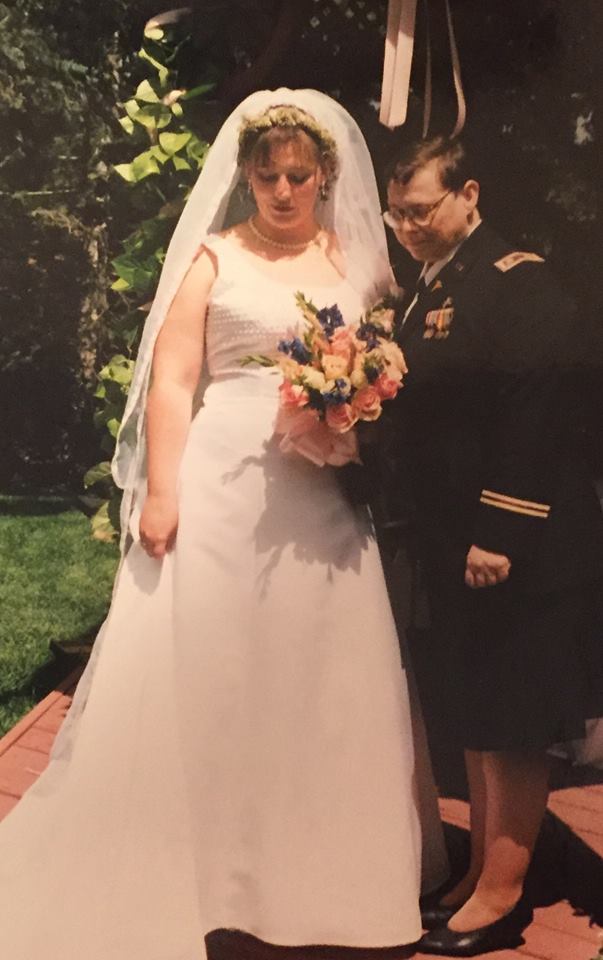
Me and my mother on
my wedding day

The week after my mother's death we started the process of cleaning, pitching, organizing and moving my father in with us.  As I did that, with the wonderful assistance of my husband and mother in law, all I could think of was a conversation I had several years ago over lunch with Denise Levenick, whose is also known as The Family Curator.

We were having lunch talk about something, what I cannot remember, but she told me that she self -curates.  I have to admit I must have gasped and looked at her funny.  Then I distinctly remember her telling me that she was serious, 'cause there were just somethings that her kids just didn't need to know or see.

I mulled that over, mostly because too many of my ancestors were the type that burned everything "not useful" after someone died.  to be fair, I am also a collector and it hurts me to throw something sentimental away. Now though, I totally see her point of view.

In the near future, I may begin to self-curate a few items myself.  It may hurt me, but in the long run, it will be well worth it.

Wednesday, February 10, 2016

Keynote Speaker from RoosTech Paula Williams Madison

Leading up to RootsTech I purchased the book Finding Samuel Lowe written by one of the Thursday Keynote Speakers, Paula Williams Madison.  Some of you may know from past book reviews that I love a good chasing-my-family story.  I knew I would have the opportunity to speak with her at RootsTech as one of the ambassadors which made me really dig in and read the book quickly. 

Paula has a somewhat unique background growing up in Harlem and rising to the top as an NBC Universal Executive.  The daughter of Jamaican immigrants, her mother half Chinese and half Jamaican, Paula and her brothers did not have an easy life in New York City.  A heritage that she decided to invesitgate more after the death of her mother.  Her book chronicles the journey she took, also filmed along the way as a documentary, to find her Chinese grandfather and the family she never knew.

During the keynote address on Thursday there was barely a dry eye in the audience.  As with any family story we genealogists sat in rapt attention through the audience.  We hung on her every word as she described her first meeting with the aunt and uncle her mother never knew and the emotions that ran deep through her. 

Paula on stage with a picture
of her mother
I was lucky enough to get to be a part of a small group who were able sit down one-on-one with Paula in the media hub at RootsTech.  In this “sofa chat” we were able to get some behind the scenes details, hear more personal thoughts on her journey, and ask questions to the man (Martin Proctor) who filmed the amazing documentary about her journey. 

She was asked what she thought the benefit to a face to face meeting was with relatives you have never met before.  Her words made so much sense, “nothing can replace a touch.”   She is correct, there is nothing in the world that can replace the embrace, caress, hand shake, and so forth of someone who is your flesh and blood.  Paula went on to tell us “no one can anticipate what it will be like” which I think is true as well.  While I have never met close relatives in this way I have met a few distance cousins and the anticipation and excitement even from those meetings were nearly overwhelming for me.  I can only imagine what she went through.

Her camera man, Martin Proctor, also gave us a look into his thought process for documenting her first meeting with her relatives.  Martin stated that “in production you had to roll with it as it evolved – you couldn’t control it… by the end I knew what was going to happen and could get ahead of her” for those powerful and emotion filled shots.  He even admitted that at times he stood there wondering where the shot was going to lead him, how would people react, and how welcoming would they all be.

Paula looking at a published
Chokbo from the Family
History Library
If you document your family history in real time I am sure you can relate to his emotions and thoughts.  I know I have had those thoughts even when dealing with close relatives.  To try and document those people who you have no contact with must have been a challenge full of surprise and apprehension. 

At the end of our chat a member of Family Search came by and surprised us with a bit of on the spot research.  Across the street, and a few blocks away, at the Family History Library there are a number of Chinese Genealogies, or chokbo (there are several different words depending on where the family came from).  Even better, they had several for the Lowe family, the two bound copies were shown to her to let her know that her linage was documented and not that far away.


To say it was an emotional surprise was an understatement.  Martin whipped out his phone and documented the event, along with several other bloggers, proving that just because the documentary was complete the documenting of her family story was not.

Friday, December 18, 2015

Post at America's Footprints

My next blog post is up at America's Footprints on sharing traditions during visits with families.  Here is a preview of the post.

Many people, the world over, partake in various celebrations this time of year. They may be religious or secular celebrations but the common theme to them is love and family.

Even if there is no snow for you in December and even if New Year's will be on a sandy beach instead of in the snow, you will more than likely share this time of year in some way with people who are close to you.

Growing up my family had many traditions from who sat where to passing over the carving duties to the next oldest in line. I always find myself reminiscing back to those past gatherings, thinking about those who are now no longer with us, and smiling.

To read the full article check it out on their blog.

Thursday, October 15, 2015

Remembering the whole family

Young woman kissing baby in bassinet. 
c1912. Library of Congress
Yesterday I taught a workshop on beginning genealogy research.  It was a wonderful time and there was really only one question that threw me for a loop. Someone asked if they should put miscarriages or still births in a family tree.  Usually, I can give a matter of fact answer to these types of questions but yesterday was different.  You see I was already thinking about the post I wanted to write for today so the subject of pregnancy and infant loss was already churning in my head.

Not only is October National Family History month but it is also National Pregnancy and Infant Loss Awareness month with October 15th being the day that those who have lost children light a candle at 7pm to remember their babies.  If you have read my blog for the last several years you know that I tend to write very openly about my story and those of my ancestors who lost also children.  

To be frank, I am very happy that I live now, in the 21st century where the discussion of these subjects are no longer a taboo affair.  Plus that fact that I am here to tell my story because even a decade before neither I or my son would have survived. 1 in 4 women will lose a child in their lifetime to miscarriage, stillbirth, or before the child's 1st birthday due to unknown causes (SIDS).  It is a statistic that seems unreal with medical advances, and many couples never believe something that this could happen to them.  That is until it does.

Recently I had lunch with a couple of friends who are also genealogists and we turned to this subject.  The three of us had struggled with our pregnancies and periodically talk about medical advances, or to just lean on each other when we need it.  That day we talked about the unnamed and unknown children in our family trees.  The uncles, aunts, and cousins whose lives were cut short.  All the stories that we were uncovering in our own family histories with the cycles of pregnancy loss and childhood death.

As I talked yesterday about including these unknown children in family trees I noticed how quiet the room became.  I have this wonderful ability that when I am "performing" I can stay on task and on target with what I am doing.  Even though the subject of losing my own daughter is usually hard to discuss I did not stumble and I gave my own thoughts on the matter with ease.  Then I noticed the glistening eyes in the room and exactly how silent everyone was.  The 1 in 4 came back to me; someone in that room had experienced what I was speaking about.

At that point I also went a bit off topic and started to talk about finding patterns in our research to help with our family health histories.  A topic that not many American genealogists talk about or do but I know is a very popular topic in other countries.  Due to my work in genealogy I was able to trace several diseases in my family as well as other patterns which have helped doctors with my own health problems.  Not only because of the number of early births and pregnancy losses in my family but also with cancers, diabetes, and other disorders. 

My answer to the question yesterday was yes, you should include pregnancy losses and childhood deaths in your charts, or at least place them in the family notes.  I especially do this is there is any type of record available with the thought that future generations are going to find it so why keep it a secret.  Most importantly though, I do it so they will not be forgotten.  Our ancestors never forgot their children who died even if they never spoke, aloud, about them again.  It may be a simple thing to put a name and a date in a family tree, one that may seem to some ridiculous since they were unable to lead a full life, but I am here to remember and honor my family.  What better way to remember and honor the memory of a family member than to make sure future generations know they were here, even if it was not for a very long time.


Tuesday, December 16, 2014

Creating new memories

This year will be the first time in a decade that we will not be spending the holidays with family. 
My kids are in a bit of a whirl wind with the unknown that comes with “what do we do at home for 2 weeks?”  The hubs and I on the other hand have it all planned out and it includes clearing out closets and steam cleaning rugs.

However, creating new family memories and possibly traditions are on my mind.  The kids don’t remember having a Christmas without their grandparents.  Which is good, but it comes with complications, explanations, and confusion. 

First there is the fact that we are only having 1 holiday dinner with presents and not 4.  There is confusion among the ranks on which day do we want/should/need to open presents and have family time.  There shouldn’t be, but it’s a consequence of traveling and meeting with multiple parts of the family over our annual pilgrimage to the grandparents. 

Now I am planning out the dinner.  How do I cook for just 4?  I am not sure I know how to cook a holiday spread for just 4 people.  Hubs and I are trying to watch what we eat but we have 2 kids going through growth spurts.  There is a fine line between enough leftovers and the thought of if I ever see [insert food here] again I will kill you.  Seriously, I just cleaned out the fridge and pitched the Thanksgiving leftovers last weekend.

We were able to continue our tree trimming tradition which, while frustrating and amusing, is always a crowd pleaser around here.  The kids are intrigued by the amount of presents that are coming in (they have never seen everything from 4 sets of grandparents all at one time) and at one point my youngest asked if there were too many.  The oldest looked at him like he had lost his mind.

But I still want to make this a memorable holiday for them.  It’s not about the presents, or the food, or which day we choose to celebrate.  Really it is all about us, our family and our memories.  Playing games, laughing, watching a bad holiday movie, and just being together.


Maybe, just maybe I can squeeze in some family history research with my kids.  Maybe, just maybe they will remember one moment from this December and share it with their family.  Maybe, just maybe…

Thursday, December 11, 2014

Yates family research time: or what you can find in a newspaper with only an hour

"The Lighthouse" from Palo Duro Canyon
State Park. Canyon City, TX borders this
park. Image from the Library of Congress.

A 2nd cousin twice removed to my husband contacted me a few months ago looking for information, and I was a bad, bad genealogist friend.  I forgot to write her back, but I thought I had.  Yeah, let the flogging begin!  So to make amends I did some quick research into a family story and whoa did I get a good surprise.

In the early days of my genealogy research I did what we are all told to do, I interviewed the family. Even if it was like pulling nails at times I tried to extract information from them in any way possible. My father in law knew some, but not a lot about his family beyond dates and names.  One statement he made to me that stuck was that someone in his maternal grandmother's side of the family owned a hotel in Canyon City, Texas. He wasn't sure if it was her father or someone else though.

Eventually I found my husband’s 2nd great grandfather along with his wife and son living in Canyon City on the 1910 US Federal Census.  Eureka!  A Canyon City connection.  At that time however, that was all I could find. 

Through the Census records I learned he was still in Missouri during the 1900 census and then returned by 1920.  However, my skills weren’t the best in the beginning so this mystery sat while I worked on lines that needed more immediate attention.  Then the email came, and I felt awful.  So I sat out last night to see what I could find in a limited amount of time. 

In the 1900 US Census[1] Eugene, Missouri, and two of their children are living in the same household in Grand Pass, Saline County, Missouri.  I have located most of his children in the general area as well.  But what happened to get him to Canyon City in 1910[2] and then back to Saline County in 1920[3]?

This is when last night I stumbled on The Portal to Texas History from the University of North Texas Libraries.  They have digitized and searchable records from all over the state of Texas.  I was able to locate 4 newspaper entries for Eugene moving to Canyon City plus then owning and selling a hotel there.

Notice in paper[4]:
“Eugene Yates, of Mt. Leonard, Missouri, moved here last week and on Monday opened up the Rogerson Hotel business.”
  
Review of Hotel:[5]
“Hotel Rogerson,
Eugene Yates & Son, Proprietors.
  One of the popular hotels in Canyon is the one run by Eugene Yates & Son- Here every guest is made to feel at home and no pains are spared to make everything comfortable.  The dining service at this hotel is hard to excel.
  The writer has traveled in almost every state in the union and can heartily say that at no hotel has he received more courteous treatment.
  All the rooms are nice and clean and the full register each day shows that the traveling public fully appreciate the excellent service the management is extending to all.  When in Canyon do not fail to register at the Rogerson.”


Notice:[6]
“Eugene Yates has quit the hotel business and will more to his residence, now occupied by Mr. Hatchell.”


Notice:[7]
“Change in Management
E. Yates, a former hotel man of this city, announces that he has leased the Rogerson Hotel in this city and will take charge next Monday.  He invites his former patrons and other to call and see him.”


Now I have a larger line of inquiry to search out which might take longer than an hour on the internet!  I will be the first to admit that my Texas research skills are not strong so if you have any suggestions on what my next steps are I would love to hear from you.


[1] 1900 U.S. Census, Saline County, Missouri, population schedule, Grand Pass Township, p 159 A (stamped), dwelling 210, family 212, Eugene Yates family; digital image, Ancestry.com (http://www.ancestry.com : accessed January 2012);  citing NARA microfilm publication T623.
[2] 1910 U.S. Census, Randall County, Texas, population schedule, Canyon Ward 3, p 10 11B (written), dwelling number 193, family 207, Eugene Yates family; digital image, Ancestry.com (http://www.ancestry.com : accessed January 2012); citing NARA microfilm publication T624, roll 1584.
[3] 1920 U.S. Census, Saline County, Missouri, population schedule, Grand Pass Township, p 9A (written), dwelling 184, family 200, Eugene Yates family; Ancestry.com (http://www.ancestry.com : accessed January 2012); citing NARA microfilm publication T625, roll 962.
[4] Canyon City News. (Canyon City, Tex.), Vol. 9, No. 33, Ed. 1 Friday, October 27, 1905, Newspaper, October 27, 1905; (http://texashistory.unt.edu/ark:/67531/metapth323011/ : accessed December 10, 2014), University of North Texas Libraries, The Portal to Texas History, http://texashistory.unt.edu; crediting UNT Libraries, Denton, Texas.
[5] Canyon City News. (Canyon City, Tex.), Vol. 10, No. 16, Ed. 1 Friday, June 29, 1906, Newspaper, June 29, 1906; (http://texashistory.unt.edu/ark:/67531/metapth323044/ : accessed December 10, 2014), University of North Texas Libraries, The Portal to Texas History, http://texashistory.unt.edu; crediting UNT Libraries, Denton, Texas.
[6] Canyon City News. (Canyon City, Tex.), Vol. 10, No. 49, Ed. 1 Friday, March 1, 1907, Newspaper, March 1, 1907; (http://texashistory.unt.edu/ark:/67531/metapth323078/ : accessed December 10, 2014), University of North Texas Libraries, The Portal to Texas History, http://texashistory.unt.edu; crediting UNT Libraries, Denton, Texas.
[7] Terrill, R. A., editor. The Randall County News. (Canyon City, Tex.), Vol. 12, No. 27, Ed. 1 Friday, October 2, 1908, Newspaper, October 2, 1908; (http://texashistory.unt.edu/ark:/67531/metapth323158/ : accessed December 10, 2014), University of North Texas Libraries, The Portal to Texas History, http://texashistory.unt.edu; crediting UNT Libraries, Denton, Texas.

Tuesday, October 21, 2014

Weekend in New York: a family history pilgrimage

Alexander Hamilton Custom House, site of the conference 
Last weekend I had a great time in New York City.  It was really the first time I have ever been on my own, for multiple days, in a large metropolis.  No kids, I kept looking for them but they really weren’t there.  Nerve wracking at first but an absolute delight once I got the first minor anxiety attack out of the way.

I was there for a conference but secretly I had a plan.  A family heritage plan.  I unfortunately was not able to make it to the NYC Archives (drat you for not being open on the weekend) but I did make a family history pilgrimage of sorts to a very small green space in the middle of the concrete jungle.

Soldier's Monument, Trinity Church
In a previous post I talked briefly about Anneke Jans and her 62 acres on Manhattan Island.  She and her husband, Roelof Jansen, were originally granted the land in 1636.  After the English government came into power she and her heirs continued to own the land through a grant from the Governorof New York, Col. Francis Lovelace.  Unfortunately, due to a technicality (missing signatures on the deed) the family lost the land after 1671.

New York City and Trinity Church purchased parts of the land at that time but it was not the end of the story.  For over 150 years, in 16 lawsuits, the heirs of Anneke Jans sued the city for their land.  Then in 1847 the final decision was made that the land was purchased legally.

The last remaining remnant of the Jans farm is now a small park that if you didn’t know was there you would miss.  On my last day in NYC I was determined to find it.  Heck it was only a mile walk from my hotel!  What’s a mile when you are on a mission?

Plaque at Duane Park
My route took me past Trinity Church, which, of course, I had to stop at.  Sunday services were occurring so I didn’t go inside but I spent a good 20 minutes looking around the graveyard.  There  were quite a few beautiful tombstones that I stopped to admire.  I also discovered the Soldier’s Monument, which was quite moving and a piece of history I did not know about.

I continued up Broadway from there eventually crossing over to West Broadway until I came to the little diagonal street I was looking for, Hudson.  The small triangle piece of land that lies on Duane and Hudson Streets lies in the middle of one of the Tribecca neighborhoods.  Row houses with red bricks and brown stones lined the streets.  The local market was putting out fresh flowers and arranging pumpkins on the front steps.  Families were out for a stroll and joggers ran by with their headphones in oblivious to the wonder I was experiencing.
Duane Park

Standing there reading the plaques at Duane Park I got that familiar sensation again. You know the one you get when you develop a connection to something that had an impact on your past.  My family once walked here.  They farmed here.  They lived and they died here.  I just sat and took in the late blooming flowers for a minute trying to feel them.

I started back south and crossed over at Church Street.   This route took me past the new World Trade Center.  Stopping on a corner I looked up and appreciated the beauty of the new tower, but unlike the mass of tourists heading to the memorial I had no desire to go.  I am not ready yet, and if you don’t know why, go back and read this post.  Thankfully, I know I am not alone.

Across the street from all of the construction was St. Paul’s Chapel.  Of course it was another attempt to feed my growing addiction to cemetery research so I stopped in.  I did not go in the building and look at the exhibits on 9/11 and the church, but I once again spent a good 20-30 minutes meandering on the path around the church craning my neck to see the markers from the flagstones.  However, my searching was not in vein.  I did find heraldry marking one of the graves and I am now researching who this person was.

The Immigrants, Battery Park
From there I did the “touristy thing” and wandered around the area of my hotel.  Took a nice stroll through Battery Park, discovered the NY Stock Exchange was 2 blocks from my hotel, saw the steps where George Washington was inaugurated out first president, and watched silly foreign tourists try to feed the squirrels acorns.  Yeah, can’t make up that last one.

By the time I was done I walked 7 ½ miles in downtown.  No wonder I was so tired on the 5 hour train ride home.  However, sleeping is nearly impossible on a train I’ve decided.  It’s not like an airplane where the constant hum of the engines lulls you to sleep.  Instead I finished my new book (The Juggler’s Children) and did some work.  Ah, the life of a train commuter. 

Friday, February 14, 2014

21 Valentine Days and Counting

Sitting here in the land of snow and ice, hot cup of tea in hand, gas fire cracking in the fireplace, my mind wandered back 21 years this morning.  Another Valentine’s Day, a world away, and to the man who helped me cope.  I think, that day, was when I realized that he would never leave.

My mother’s mother was living with us.  Well not anymore.  For several months her home was the hospital as they tried to make her comfortable and treat the cancer that was way too aggressive.  Grandma had already had a double mastectomy from the breast cancer, but it had spread.  She came home from the surgery for a few months.  A frail woman with a walker but her wicked sense of humor intact. 

Honestly, I knew what was going on, but in a way that is unique to teenagers, it never sunk in.  I am always amazed at how kids can compartmentalize and at times shut off parts of their brain when they can’t cope.  Grandma was sick, I knew that, but death never crossed my mind.

It was very early on Friday 13 February 1993 when my bedroom door sprang open.  My dad yelled my name and I groggily sat up in bed.  He was silhouetted in the doorway buttoning up his shirt.  In my half-awake sleep I heard something happened to grandma and he was going to the hospital.  I waved and went back to sleep.

My alarm went off at 6AM.  I got up, stumbled into the bathroom and started my morning teenage preening session.  It was in the middle of the shower that I remember the early morning exchange.  I also knew grandma was dead.  Dead.  She was gone.  Off went the water as I bolted around the house
yelling for my dad.  Gone.  I was alone.

I sat in the hallway and cried.  What do I do?  Dad took me to school in the morning since I had to be there early for sports training.  The clam, collected, part of me took over.  After getting dressed, packing my bag, and having breakfast I called my boyfriend.  Yes, it was 7 AM, but I knew he was getting ready for zero hour too.

What I said has left me, but what I felt hasn’t.  Standing in the living room looking out over the early morning sunrise on the mountains I asked for a ride.  Sniffles started.  Next the gasping like a fish out of water.  His response of I’ll be right there and we hung up.

It only took 20 minutes, but I was still alone.  I sat near the front door, pulling myself into a presentable form.  The ride to school was quiet.  I sat on the other end of the bench in the truck, an arm’s length away.  We pulled into the parking lot, the truck turned off, and a single tear ran down my cheek.  Looking out the window I felt his hand and on mine and I could no longer hold back.  We sat huddled in his truck until I stopped.

Edmund Blair Leighton - Abelard and his Pupil Heloise
We didn’t go to school that day.  He took me to breakfast at the Village Inn.  He took me to see his horse.  We sat in the desert and talked.  After lunch I came back to school to get my stuff for the weekend, and so he could go to Calculus.  We weren't in trouble since my boyfriend’s mom, a teacher at the school, had already signed me out.  

He called and checked on me that night.  We were supposed to go out for a surprise the next day, but it was okay if I wanted to be with my family.  My dad was there, my uncles too, but my mom was on TDY in Washington State.  There was nothing for me to do but sit and watch the adults make plans and arrangements.  My dad said get out of the house.  Who knew when I would be able to do it again?

We were supposed to go horseback riding.  I hadn’t told him yet exactly how scared of horses I was, but it is weird what you will do when you are still in those first few months of making a good impression.  He put me on his paint ’Chach, short for Muchacho, to warm him up.  The horse hated me, I hated him, and it was the most uncomfortable 10 minutes of my young life.  I swear he tried to dump me off the saddle a couple of times and my darling kept the smirking to a minimum.

That is when he informed me that our horse riding and picnic were not going to happen.  His dad had the other horse and was at an arena a short ride away at a practice roping.  You see they were real roping and riding cowboys who actually won competitions and stuff.  Wow, uh, okay, what were we going to do?  With his toe in the dirt, looking at me from under the rim of his hat he invited me to come watch.  Why not? I climbed up behind him and we rode together down the irrigation ditch to a new experience for me.

Well, I did more than watch that Valentine’s Day.  I earned his step-dad’s seal of approval.  How you ask?  Well, I turned out cattle, got muddy, helped clean up, laughed at all the right times, and most importantly was not put off by the change of plans.  Sounded like I was the perfect girlfriend.

I don’t remember the rest of the day.  We probably ate somewhere (What-a-burger most likely) and he eventually took me home.  It’s what we didn’t do that has always stuck with me.  Our first Valentines was a roller coaster of emotions and he came out with top marks.  When he came to the house that morning I was a mess on the inside and my dad probably wanted me out from under foot.  There were more people at the house than I was used and it was freaking me out.

I think I started to fall for him that morning.  Sitting on my bed watching me put my boots on he made sure I still wanted to go.  We could always go back to his house and watch TV.  No, I needed to get out.  I remember frantically looking for something, a belt maybe, and he grabbed my hand.  Pulling me in, sitting me on his lap, as he wrapped his hands around my waist and hugged.  A calm, simple, needed hug.  He didn’t have good timing though since my dad walked by just then and gave him the I’m-the-father-and-she-is-my-only-daughter glare, but dad didn’t say a thing.


The past 2 decades have been full of those simple, needed, quiet hugs.  Our February 14th dates are never loud, boisterous, or over the top.  Perhaps we set the tone all those years ago.  Sometimes, I think my grandmother was nudging too.  She really liked him, she kept telling me for months I should give him a chance.  I think she would have been pleased as punch with the outcome.

14th Century Manesse Codex

Thursday, January 23, 2014

The Book of Me Written by You: Still chugging along

I have been plugging and chugging away on this project, but not online.  A lot of the topics have called for more intimate reflection and even though I love you all, it is the internet.  So, I have taken to writing my thoughts on the weekly subjects in a word document.  One day it should make an interesting heirloom for the ancestors to read.

We are up to week 21 for those of you who were wondering.  If you want to start from the beginning you can go to the website for the creator of this prompt and check it out. Julie Goucher writes the blog Angler's Rest and she has an excellent post to get get you started.

Of course the questions and topics that she asks has just given me fodder to send on to my parents and in-laws for the books I bought them 2 years ago.  A couple of them admitted that they hadn't written in them yet when we visited last.  I told them that was okay, I don't want to push, but I did get my spirit crushed a little.  I hope they keep their promises of trying to answer my boys questions, and adding more, because 1) the boys really want them to and 2) I think this will be a great piece of history for the kids after their grandparents have passed.  Which lead me to thoughts that I need to keep up with this project.

There is not a better time for you to try a hand at journal writing if you don't already.  First, and the easiest way I think, is to turn a research journal into a more personal one.  While the research geeks in us love all the tid-bits found in a well organized research journal, think about the other things you could add that will make you family wish they knew you better in the future.  What was the drive like to the repository?  Any stories about the people you are researching that might get lost in a generation or two?  Well, why not write them down where you are adding the facts?

Alright, back to the grindstone.  Classwork, researching, and writing projects are on my to-do list for the day while my kids enjoy, another, snow day.  Sigh...