Search This Blog

Translate

Showing posts with label Mott collection. Show all posts

Monday, July 29, 2019

The Mott Letters: Enslaved Persons


Descendants of enslaved persons struggle with that is known as the “slave wall” in American Research. This wall is defined as the period before the 1870 US Census, which was the first census many former slaves were named.[i] Before the US Civil War existing records on slavery are limited, and far fewer exist which name the slaves owned.

When a new record set which contains the names of enslaved person is discovered this information typically documented at the repository so other researchers can find the data to determine if it will aid in their “slave wall” research. In Virginia when new records are found institutions are encouraged to send copies to the “Unknown No Longer: A Database of Virginia Slave Names” for use by patrons of the Virginia Library and Archives.[ii] 

The Mott letter collection has a few names of slaves included in its pages, not only from Virginia but also with the extended Mott family in Kentucky, and in South Carolina. As a collection, which until now, was only seen by family members, these names and details may help a future researcher break the slave wall for their family or client.

The table below shows the named slaves, unnamed slaves, and person who were possibly slaves from the Mott letter collection. Since these families were confirmed slave-owning families through secondary sources, I presumed that mentions of maid or types of “help” referred to a slave.

We can be sure Sarah was a slave in the Bentley home, but only on loan to them from another person. Since Nancy, also identified in the letter was offered in trade, we can also label Nancy as a slave.


 Identified and possible slaves identified from the Mott letter collection.
Figure ID
Name
To Whom
Date
1840_12_29_VM
Hannah
slave/servant to the Bentley family

1840_12_29_VM
Joe
slave/servant to the Bentley family

1840_12_29_VM
Nancy
slave in the Bentley family

1840_12_29_VM
Sarah
Loaned to Bentley Family
Before 29 Dec 1840
1840_12_29_VM
None
Robert Bentley purchased 2 “servants”
29 Dec 1840
1842_10_15_VM
Sandy
slave/servant to the Legaré Family

1844_08_02_AM
Old Tom


1844_11_05_AM
Jimbo
Mr Gilchrist
Before 5 Nov 1844
1844_11_05_AM

Albert Long
Before 5 Nov 1844
1845_02_17_AM
Lucy
slave/servant to Mary E Martin

1845_04_10_AM

Robert Winston's Mother
Before 10 Apr 1845
1846_10_28_VM
Rose
maid / slave to Lizzie Legaré


"Sarah has left and gone to live with her Master, she did not like the idea much of leaving. Father proposed buying her off her master or trading Nancy for her, but her master said he could not part with her."

Due to the loss of Sarah Robert Bentley, father of Virginia Bentley purchased servants on 29 December 1840. These persons were slaves as indentured servitude was no longer practice at that time in Virginia.

"Father went down to Prince William this morning to purchase a servant for the house and one for the farm"

However, no records were located for a bill of sale at that time. They were either lost, destroyed, or not recorded.

Mary related information to her brother about slaves in possession of friends and extended family. Sometime before 5 November 1844 she tells Armistead that “Mr Gilchrest’s Jimbo” died. While there were no records found for slaves in 1844, there was an RJ Gilcrest on the 1850 Slave Schedule for Union County, Kentucky where Mary lived at the time.[iii] In the same letter, she relates that their Uncle Albert [Long] sold more of his slaves, but a bill of sale was not found.

Knowing when and where a slave was sold are clues used by researchers to build cases for placing slaves in a time and place. Unfortunately, no existing records were found for Albert Long owning slaves, but that does not mean he did not or that he did not bring them with him to Kentucky from Virginia.

With the limitations of this project, research into the Winston family also did not take place. However, descendants of the slaves associated with Robert Winston, who according to Mary Mott Martin inherited slaves from his mother’s estate, may not have known their ancestors were originally from Virginia. In her letter to Armistead, she stated

"Robert has inherited some negros from Mrs Rs estate which he expects to carry out. He will buy a light wagon in which we will all over out we will be provided with a tent under which we will expect to lodge.”

At this time without further detail, the identification of who his mother was and when he collected his inheritance is not known. That fact does not mean this information is not significant, however.


[i] Griggs, Cara F. (2015) African American Research at the Library of Virginia to 1870. Library of Virginia. https://www.lva.virginia.gov/public/guides/AA_Genealogical_Research.pdf : March 2019.
[ii] Virginia Museum of History & Culture. Unknown No Longer: A Database of Virginia Slave Names. https://www.virginiahistory.org/collections/unknown-no-longer-database-virginia-slave-names : accessed March 2019.
[iii] Census records. USA. Slave Schedule. District 1, Loudoun County, Virginia. 1 June 1840. http://www.ancestry.com : accessed February – May 2019.

Friday, July 26, 2019

The Mott Letters: Antebellum Charleston, South Carolina


An interesting facet to many letter collections is the discovery of information which is not familial. The data often gives the reader insight into a completely unrelated subject or subjects. This occurred in the Mott collection with a series of letters from Elizabeth, also known as Lizzy or Lissy, Legaré who was a Charleston, South Carolina socialite and school mate of Virginia Bentley.

While these letters are an exciting surprise for those who read the Mott collection expecting to learn more about Leesburg families, discoveries like this are more common than not. The Legaré letters show that one should not assume a local letter collection concerns only the local people.

The insights from her letters about the persons who lived in antebellum South Carolina are of great value for researchers. Letters and personal manuscripts are often the only records in existence for many of these persons. South Carolina’s record loss was extensive due to the burning of courthouses, and towns, during the American Civil War but official vital record registration was not instituted until the late 19th – early 20th century.[i] These factors make researching Antebellum ancestors particularly tricky.

A prolific writer, 16 letters survive from Lizzie to Virginia Bentley during the period studied, the most from any person outside of Virginia’s Family.  The largest category of the genealogical event she wrote about concerned travel. Who went where, who was visiting whom, and who had moved residences. This information can thus place an individual within a time and place for genealogical study.

For genealogical research the information Lizzy provides on her family structure, those who were in her immediate sphere, and snippets of gossip help fill in the details of an ancestor’s life which might have been covered with formal records. She documented births, deaths, marriages, engagements, and of course, social functions which occurred since her last letters. These statistics can be seen in the image below.

 
Genealogical events stated in letters from Elizabeth Legaré Blake to Virginia Bentley Mott.

Many of Lizzie's letters discussed her social circle in Charleston. Descriptions of balls, dinners, and general entertainment may seem like superfluous information, but for genealogy research, the details are what is essential. The names listed are not only among the Who’s Who of Charleston, but they will build out the FAN (friends, associates, and neighbours) network for an individual. This network is crucial to research in areas with missing records.

As an example, in a letter dated 21 October 1843, Lizzie wrote to Virginia (Gin) about a bit of gossip told to her by a friend (Eliza) about a classmate (Maria Payne). While this could be titled gossip, an intimate dinner party and evening of entertainment was described. Genealogically speaking very important as the people mentioned are now associated with each other, at least as acquaintances.

“… well said Eliza, Lizzy I will tell you Miss Payne is not a true friend of
yours. The 6 weeks since she invited to spend the evening with her, and also John Lance, Louis Gervais, Mr Mottet, Julian Barksdale, and Arthur Rose, and in the course of the evening Mrs Payne called me to the Piano saying here Eliza is a list  of Rias premiums which I will show you, I wish you to see how far superior Ria is in every respects to Lizzy Legaré, the latter is reputed by some people in Charleston to be smart but I will show you her smartness amounts to nothing her conversational powers are pretty good an that is all, and further she said, Ria was in the Senior Class and Lizzy Legaré is the first, and would you believe it Gin …”

Of course, from her letters, the reader learns about her immediate and extended family. Who was married, who died, and who was doing what? The pedigree chart below shows the family relationships discussed and inferred from Lizzie's letters. Her mother is not mentioned in the letters by name and was determined by secondary resources and published genealogies.[ii]

 
Lizzie Legaré's immediate family.

Health was discussed frequently, and often in detail. Lizzy herself was frequently ill with fevers[iii] and did suffer a miscarriage[iv] early in her marriage to Jonathan Blake. Her most in-depth letter on a health matter to Virginia was the description of her husband John dying from consumption. The details of the illness, how it progressed, who treated him, and his ultimate death are invaluable details to a researcher from this family.

Lizzie was the consummate socialite with family and personal connections to the most respected families in Charleston, and out. As such, she had the opportunity to attend activities and meet people of historical significance. One of the most detailed and intriguing letters written by Lizzie was the description of her aunt “Matties” wedding.

Martha Washington Seabrook was an aunt (by marriage) to Lizzie. Her stepmother Sarah Seabrook and Martha Seabrook shared their father William Seabrook as seen in the pedigree image below.[v] Sarah being born of his first marriage to Mary Ann Mikell and Martha by the second marriage to Elizabeth Emma Eddings. Martha Washington Seabrook married the grandson of the Marquis de Lafayette, Ferdinand de Lasteyrie. Lizzie related the story of the Paris wedding and the thousands of dollars in gifts in her letter to Virginia on 28 October 1846.[vi] A connection such as these only elevated their status in Charleston.


Association of Elizabeth Legaré Blake to Martha Washington Seabrook.


Another famous grandson Lizzie wrote to Virginia about in January 1849:

“On the 8th Jan Henry W[illiamson] gave his birthright [sic] supper … Schuyler Hamilton N[ew] York, one of the heroes of Mexico, was there and a quad of army officers…”

Schuyler Hamilton (1822 – 1903) was the grandson of Alexander Hamilton, first Secretary of Treasury of the United States, and Elizabeth Schuyler. He was visiting one of the Forts in the Charleston Area having returned from the Mexican American War (1846-1848).  At the time meeting, a war hero was impressive, but his lineage perhaps not so much. However, now, this connection is historically significant.

Her letters continue with a detailed description of the Legaré family, the Charleston community, and other women Virginia and Elizabeth attended school within Maryland. The quantity of and notes can be seen in the raw data located on the attached thumb drive. 


[i] FamilySearch. “South Carolina Vital Records.” https://www.familysearch.org/wiki/en/South_Carolina_Vital_Records : accessed March 2019.
[ii] Fludd, C. K. (1886) Biographical sketches of the Huguenot Solomon Legaré and of his family, extending down to the fourth generation of his descendants. Also, Reminiscences of the revolutionary struggle with Great Britain, including incidents and scenes which occurred in Charleston, on John’s Island, and in the surrounding country of South Carolina during the war. Charleston, South Carolina: E. Perry. https://lccn.loc.gov/09024035 : accessed 18 June 2019.
[iii] Blake, Lizzie. (1844) Letter to Virginia L Bentley, 30 June.
[iv]  Blake, E W. (1845) Letter to Virginia L Bentley, 8 March.
[v] Webber, Mabel L. (1916) Early Generations of the Seabrook Family. The South Carolina Historical and Genealogical Magazine. 17(2). p. 58-72. https://www.jstor.org/stable/27569389 : accessed May 2019.
[vi] Blake, E.W. (1846) Letter to Virginia Bentley, 28 October.

Wednesday, July 24, 2019

The Mott Letters: The Case of the 49er


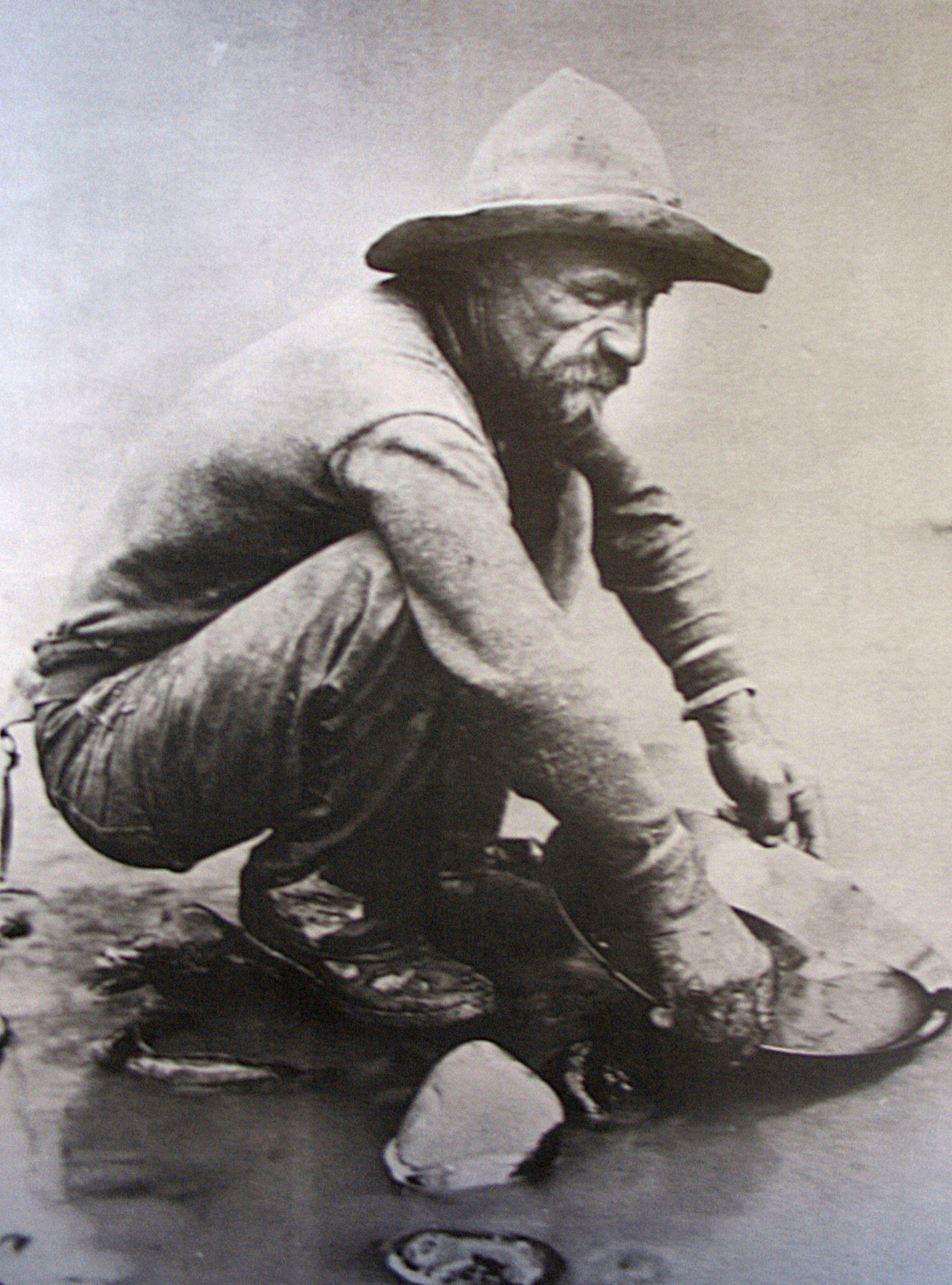
Most historians believe the 1849 California Gold Rush was one of the most significant events which occurred during the 19th Century.[1] The event saw thousands of Americans travelling overland and by sea to the California Territory after the initial reports of gold being found at Sutter’s Mill on 24 January 1848. This mass migration saw the non-native population of California grow to over to 100,000 in one year.[2] In 1849 $10 million in gold was mined, which only fuelled the movement of more people who willing to try their luck.

Many Americans have stories of 49ers in their family lore. Most, however, are not provable, only accounts with no proof. With the case of the Mott letter collection, we have verification of several members of the family travelling from Kentucky to California in 1849.

Several overland migration routes from the east coast to the west coast of the United States were taken by those wishing to find gold. One path was the California Trail. Which, from the descriptions in the letters collection, is the one the Mott family members took.

The first letter which mentions travel to California is dated 26 January 1849. In a letter from Burgess Mason Long to Armistead Randolph Mott, Burgess stated:

“I received a letter from Uncle Jack on the 24th he says that he is going to California to dig for gold.”[3]

Uncle Jack refers to Leonidas Jackson Cralle, son of Beverly Lindsey Cralle and Nancy (Ann) Rosser. His sister Calista Cralle married Armistead Long who was the uncle of Armistead Randolph Mott through his mother, Mary Chichester Long.  

The second letter addressed to Armistead was dated 12 December 1849 from his sister Mary Eleanor Mott Martin.[4] In it, she relates to him the news which came to her in another letter describing the travels of several of their family and friends.  This included Mr Cralle, most likely Uncle Jack referred to by Burgess.
  
Relationship of Burgess Ball Long to Armistead Randolph Mott

Based on the places described in the letter from Mary, a large party left Union County, Kentucky and primarily followed the California Trail to Sacramento. The known routes for the gold rush, and westward, migration is below. By comparing this information to the descriptions in the letter, it becomes clear which overland route was taken.

Map of the California Trail from South Pass, Wyoming to northern California, including the many end trails. From FamilySearch Wiki.

 The men who left for California were Mr Cralle, Gip Winston, Gerry Winston, William Winston, Dr Winston, Mr Robertson, Sam Taylor, William Edwards, and Dr Jones. After reading the letter, it appears three groups travelled part of the way together but eventually separated for unknown reasons. 

Group 1 consisted of the Winston family (Gus, Gerry, William, and Dr.) and Mr Robertson. From the letter:

“They endured great hardships the other side of the Salt Lake, and in crossing the snowy mountains – owing to the burning of the grass … they passed the sink of the Humboldt River, their oxen became weak they had to abandon it … they walked the rest of the way.”

Looking at California Trail image they most likely travelled the red line for the California Trail and then the pink line for the Truckee Trail. Since the Salt Lake was mentioned, it is unclear if they took one of the cut-offs that merged into the California Trail. The letter states they made Sacramento in October of 1849.

Group 2 consisted of Gip, Mr Cralle, Sam Taylor, and William Edwards. From the letter:
“Mr Cralle’s company went by the Salt Lake and stopped with the Mormons – sold their wagons and effects and went the rest of the way on pack mules.”


To get to Salt Lake (presumably Salt Lake City), the groups parted in Wyoming or Idaho. Group 2 took either the Salt Lake Cutoff, the dashed red line on the image, or Mormon Trail, the dashed purple line. This group then had two choices to continue to California. Either the Hastings Cut-off or Central Overland Trail. To end in Sacramento, this group then took the Carson City Trail, shown as the solid blue line on the above image.

Group 3 was described as “Dr Jones and others”. From the letter:

“Dr Jones and many others took another route, shorter but farther north and said to be better, but they have not heard of them for three weeks.”

It is unclear which route the passage describes. Perhaps the Oregon Trail or a cut-off showed as green lines on the trail image.

Migration routes such as these are crucial for family history research primarily as they place people in a time and a place. Mainly because several of these men did not return to Union County, Kentucky, for example, Leonidas Jackson Cralle stayed in southern California for the rest of his life.[5]

Second, letters describing the migration of family units show how family groups migrated together. It is hard to determine family connections by looking at names written on a piece of paper. However, with the aid of two letters, familial and community relationships not measurable in other ways were defined.


[1] Corporation for Public Broadcasting. (2019) “The California Gold Rush.” American Experience. https://www.pbs.org/wgbh/americanexperience/features/goldrush-california/: May 2019.
[2] History.com Editors. (2019) “California Gold Rush.” History Channel. https://www.history.com/topics/westward-expansion/gold-rush-of-1849: May 2019.
[3] Long, Burgess M. (1849) Letter to Dr Armistead R. Mott, 26 January.
[4] Martin, M. E. (1849) Letter to Dr Armistead R. Mott, 12 December.
[5] Death index (CR) USA. California. CRALLE, L.J. 8 January 1909. California, Death and Burial Records from Select Counties, 1873-1987. https://www.ancestry.com : accessed May 2019. Monumental inscriptions. USA. Armona, Kings County, California. 6 January 1909. CRALLE, Leonidas Jackson. Find a Grave Memorial: 52491006. https://www.findagrave.com : accessed May 2019.