Search This Blog

Translate

Showing posts with label genetics. Show all posts

Tuesday, October 17, 2017

Creating a Research Plan for DNA Testing

Most people simply take a DNA test out of curiosity.  Some really want to the DNA to help them shed light on a family mystery or break down a brick wall.  Unfortunately, simply taking a DNA test will not help you to answer your questions.  These tests can throw open the closets on family secrets, but they also should be treated like another record source.

DNA is an excellent tool when used correctly.  I like to tell people to think of your DNA results the same way you would any other record.  It can give you some answers, but it can also leave questions.  To get the most out of your tests you need to know what questions to ask and which tests will answer those questions.

With that thought in mind you can easily incorporate DNA testing into your research plans.  What is crucial for you as the researcher is to determine which test you should use to answer your question(s).  Remember you may have to perform a variety of genealogical research as well.  This includes finding living descendants of your ancestors who could hold the genetic material you need.

There are 5 steps to successful a great research plan.  As a researcher, you need to:
1.      Ask questions
2.      Look for information
3.      Speculate about the answer
4.      Establish the facts
5.      Explore what else should be researched (like DNA)

You can turn this list into a written narrative or leave it as a simple list.  Whatever works the best for you is what is important.  I tend to do a little of both, which you will see in the example plan section below.  I can tell you that if you follow these steps you will go far in your ancestor hunting.

Ask: What do I want to discover?  Often this is called your objective or research question.  Ask yourself what specifically you want to find.  Be detailed and only ask one question at a time.  For example: Who was the father of John Jones, born in New York City, 24 May 1893?

That is a great specific question.  If you just asked “who were John Jones parents” that is too vague.  Which John Jones?  Where? When? You want to ask a question that will have only one correct answer.  It could ask about a person and their relationship to someone else, to verify a person’s identity, or for verification of an event that took place. 

Look: What do I know? After you decide what you are researching you should look at your files to determine what you already know.  Pull together all of your information into one place and start to analyze it.  You also want to take into consideration how reliable are the sources you are looking at.  Remember back to chapter 1 when we talked about types of sources, information, and evidence.  Those guidelines will help you determine how much credence you put into the documents laying before you.

Speculate: Do I have an idea of the answer? Sometimes after looking through all of the information you have gathered you might be able to make a hypothesis for the answer to your question.  You may hear genies talk about serendipity or that they were guided by their ancestors.  I like to say it was good detective work that gave them a gut feeling on what they needed to do next.

Whatever you would like to call it see if you can develop an idea about what happened.  You may end up with a handful of ideas, which is great.  Those will be the places you will want to check first in the next step. 

Establish: Where should I look? This can be one of the hardest things for a new researcher to do, determine where they should look for records.  Since you are new to the field it may seem like an uphill battle.  You will need to educate yourself on what is available for the location and time frame you are interested in.  Maybe you will need to start out by interviewing family members on the problem.  They could lead you to resources that you didn’t know existed. 

Explore: What should be done? Ok, now you should think about what you need to research.  Start to determine if there is a type of record you should look at first or maybe a database you need to consult before other research begins.  This part is where your plan comes together.  Take all this information and collate it into one document

Simply follow your research plan, tweak it was needed, and you will discover that research really is not that difficult.  For DNA testing the hardest part might be finding willing participants.  Persist, ask, and look for the people who potentially hold the answer to your questions.


Resources:
Genetic Genealogy in Practice by Blaine Bettinger and Debbie Parker-Wayne

The Family Tree Guide to DNA Testing and Genetic Genealogy by Blaine Bettinger

Family Search Blog: Using atDNA Testing in Your Genealogy Research https://familysearch.org/blog/en/fishing-tips-autosomal-dna-test-results-genealogy-research/

BCG Website: DNA and the Reasonably Exhaustive Search by Judy Russell http://www.bcgcertification.org/skillbuilders/skbld141.html


Tuesday, July 19, 2016

I've got a GRIP

This week I am very excited to be attending my first GRIP (Genealogical Institute of Pittsburgh). In the past there was always some sort of conflict.  Usually a kid’s summer camp.  But, this year, it looks like I get to be the one who attends summer camp!

Yes, I called this summer camp.  It really, really is summer camp for genealogists and I am not the only one who is referring to it that way here.  I never went to sleep away camp as a kid so I personally don’t have a comparison, but I am assured this is nearly as good if not much better!

During my week here I am taking the Advanced GenealogyCourse taught by Cece Moore and Blaine Bettinger (along with several other one time instructors).  Yesterday was the first full day of courses, but I had internet issues so no posting since I got here Sunday.  Besides the instruction I am meeting new people who share the same interests I have.  Which is always a plus!  There are 49 people in my course (very large for GRIP) and while I am may not make a close connection with all of them, I think coming away with a few new connections is a good thing.

Yesterday I got up God Awful early (new internal clock thanks to my new job) and I took a walk LaRoche College Gardens, or chatting on Benches.  This is really a beautiful place.  Thankfully we only had a mild rain storm which took off the humidity so the weather has been very pleasant.
La Roche College at sunrise (yes, I was up early)
around campus.  It seems I wasn’t the only one who couldn’t sleep and I saw many of my fellow GRIP attendees out walking, reading in the

Then in class yesterday we had a bit of review and the beginnings of delving deeper into analysis tools for genetic genealogy.  Today is so far building on those lessons and taking it one more step.  I am excited to get to the case study sections and learn more about practical applications of these skills. 

Oh, and Maia’s Books is here.  You know that always means trouble. Good thing I flew and have limited space for books!


Fingers crossed I will write more tonight, tomorrow, and the rest of the week.  GRIP ends Friday, so if you don’t hear from me… well my internet went down again or I am up to my eyeballs in spreadsheets.  Either way, I will catch up with all again soon! 

Wednesday, April 13, 2016

DAR and genetic genealogy one step closer

DAR Library, Washington DC. Photo by Shannon Combs-Bennett

On the Today's DAR blog there was an exciting headline:  "DAR is Expanding its Work with DNA for Genealogical Research" Wow!  I had to read the article through several times before I was able to write this post.  To say that this isn't exciting would be lying.

Go and read the blog post.  It is packed full of so much information that I would not do it justice to list everything here.  The important thing to note is that the DAR and FTDNA are working together again on a DNA project.  Yep, did you test with FTDNA and are a DAR member?  If you said yes then go put your DNA in the project.

Why?  Well currently they are accepting any type of DNA (atDNA, yDNA, or mtDNA) from members or THEIR FAMILY into this group (Surname Project NSDAR).  It is being overseen by staff genealogists at the DAR and they can then use that information to help with hard to prove ancestors.

Better yet, if you have been putting off testing FTDNA has discounted rates for DAR members and their family.  So, as the NSDAR Register General, Sharon Withers, stated today "be a DNA pioneer - join the NSDAR DNA Group!"

Thursday, April 7, 2016

Kailos Genetics and TapGenes Partner to Help Consumers Understand Health Risks

Agreement enables customer sharing of family-related health data including genetics, family history and phenotypic information.

Kailos Genetics, a personalized medicine information company offering leading-edge gene-based testing, today announced a partnership with TapGenes, a technology platform offering families the ability to crowdsource their health information. Kailos and TapGenes are combining capabilities to give people the tools needed to easily exchange critical health information acquired through genetic testing. This includes gauging the risk of breast cancer or understanding the effectiveness of certain medications among family members.

By leveraging family health history, a person improves the chance of detecting an inherited medical condition by 20% compared to just referencing medical records. The TapGenes Family Health Tree gives users a centralized platform to store and share health information – such as their genetic data results from the Kailos test – allowing them to see and understand hereditary health trends. The partnership provides simple yet secure means of communication among family members to discuss crucial health data that can impact individual healthcare.

“We are excited to work with Kailos Genetics to empower patients with health information,” said Diana Massey, chief operating officer at TapGenes. “By providing convenient access to genetic and phenotypic data, patients and doctors can proactively tailor health plans based on hereditary patterns. This can include assessing risk of breast cancer or ensuring medicine dosage is correct based on genetics.”

Once consumers upload genetic health information, a broader picture of how their DNA and hereditary health benefits or risks can impact family members is generated through the secure platform. Patients can then control who has access to their personal data. For Kailos, genetic test results will only be shared with the individual and their approved physician.

“It’s our goal to help people better understand their health so they can live healthier lives. Collaborating with TapGenes enables us to do this through giving people a map that securely reveals genetic information, family history lineage and personal data,” said Troy Moore, chief scientific officer at Kailos Genetics.


To learn more about the Kailos and TapGenes partnership, visit www.kailosgenetics.com/partnership. 

Friday, February 5, 2016

DNA Panel at RootsTech Innovator Summit

 For the first time (ok, I have only ever been to RootsTech one other time) I attended the Innovator Summit on Wednesday.  Confession: I did miss the keynote because I was helping set up a booth so I didn’t get to see everything.  What I did see…amazing!

First off, it was wonderful to see so many young genealogists at the event.  Yes, it may be the tech focus of the conference, so many people expected a younger demographic to be there.  However, there was a large presence of young genealogists ranging from late teens to fresh out of college.  To me, it was the proof that the young genie demographic is alive and thriving! YES!

I also was able to attend a panel discussion on DNA.  To be honest, I wasn’t sure what to expect, but heck, it’s DNA.  You know for that one fact that I had to attend right?

The panel was Dr. Scott Woodward, Judy Russell, and Diahan Southard moderated by Scott Fisher host of Extreme Genes: Family History Radio.  There were no questions taken from the audience, but instead it was a preselected set for each panelist.  Even so, the questions asked and the information given was timely and on topic.

Panel for the DNA session
Judy was, of course, asked about ethics and genealogy.  It made me very happy that this issue was brought up.  Ethics is always a sticky topic, one that many genealogists stumble on frequently.  Add in the issues of genetics and the already sticky situation then becomes quick sand.  Judy made several good points, including that any time you deal with family information ethical issues should be looked at.

More importantly, she took the stance that I have since the beginning.  Genetic data belongs to the person who gave the sample, period.  Why this is a question I do not understand.  After many lectures I have people come to me on both sides of this predicament.  Those who feel that they paid for it, so it’s theirs to control.  Then those who want to know the results and are shut out by the person managing the test.

Yes, this is a conversation that obviously needs to be had more and more.

While that might have been the most electric discussion of the panel, there were quite a few other great points brought up.

For instance, I really liked Dihan’s answer when asked what products or spin-offs she thought were out there for the taking.  She hit the nail on the head with the industry needs companies (or people or groups) to create nice ways to share genetic results with people.  We all know that Ancestry allows you to send the ethnicity picture out to people, but it would be great if there were ways we could easily share more types of genetic information with our family.

Why family? For me, they are the ones that we need to get and keep interested.  If we could share information, explanations and our enthusiasm with our relatives I honestly believe that many more would understand the thrill.  It can take most people weeks if not months to fully understand their results.  Why should we expect our family to feel our excitement when we show them a DNA result and they have no idea what it means?  I mean I love my husband, but at times, he shows me a techie thing and my eyes glaze over while I nod my head.  We all do it with our own family and genealogy.

Overall it was a good day, and I am so glad to be back at RootsTech 2016.

Wednesday, February 18, 2015

Keynote Speaker at the Fredericksburg Family History Day

I am very honored to give the keynote at the Fredericksburg, VA Family History Day on March 14, 2015.  If you are in the area I hope you will be able to come out and participate in this free day of family history exploration.

The theme of the event is "Threads that Bind." Staying true to the theme, I was asked to speak about the ever growing field of genetics in genealogy.  To me, genetics is the threads that bind us to our ancestors.

If you have heard my genetics lectures in the past don't be afraid that you will hear the same old lecture again.  Yes, I will have some of the same information (basics never change) but there will be a lot of new information as well.

I look forward to seeing many of you at the keynote or at my other lecture on using heraldry in genealogical research.

Monday, January 12, 2015

Genetic Genealogy Standards Published

On the heels of the APG Professional Management Conference (which was great, by the way, even from my house!) The Genetic Genealogy Standards Committee released the document of standards they have worked on for the last year.  Many people are blogging about it right now (such as The Legal Genealogist and The Genetic Genealogist) so make sure you read all the commentary about it from these sources too.

This process started in 2013 and then took off in earnest in the spring of 2014.  Which, it should have.  The genetic genealogy community strives for excellence and consistency with paper genealogy researchers, but to be honest some people are still finding their footing.  It’s not like there was a BCG manual on genetic genealogy out there to use as a guide for those interested.  There was some controversy in fact among some genealogists over what standards there should be, laws in different states and how genealogists should proceed. As an example see the NGS Quarterly vol. 101 no. 4 December 2013 editorial “DNA Standards” and the response here.

However, shoving a round peg into a square hole isn’t always an answer.  This niche of study is too different and still evolving.  This is why I was so happy to wake up Sunday morning to these standards.  As a unique field among genealogists, which is advancing more quickly than lecturers can teach about it, we have a responsibility to follow ethical genealogical practices but also those of scientists. 

The committee consisted of CeCe Moore, Blaine Bettinger, David Bachinsky, Traci Barela, Katherine Borges, Angie Bush, Melinde Lutz Byrne, Shannon S Christmas, George T. Cicila, Michael Hait, Tim Janzen, James M Owston, Ana Oquendo Pabón, Ugo Perego, Steven C. Perkin, Ann Turner, Debbie Parker Wayne and Jennifer Zinck.  They have created a wonderful starting place for this niche and yes, I say starting place, because just as science is constantly developing I am sure these standards will too. Everything evolves over time, it has to or it will become obsolete. 

Particularly important was this paragraph in the introduction of the standards:
These Standards are intentionally directed to genealogists, not to genetic genealogy testing companies. As used in the Standards, the term “genealogist” includes anyone who takes a genetic genealogy test, as well as anyone who advises a client, family member, or other individual regarding genetic genealogy testing. However, it is ultimately the responsibility of those taking a genetic genealogy test (“tester”) to understand and consider these standards before ordering or agreeing to take any genetic genealogy test.
I can’t stress how much I agree with this statement.  Nearly every day I come across someone who has tested and they really are not sure what the results say or how they find out that information.  I am not suggesting you need a genetics degree to do this but I do think that having a basic understand of procedures, companies and what your goal is would be great.  Sure, in an ideal world you would work with another genealogist who has this expertise (just like I really should go and find a researcher to help me with my Irish ancestry) but we all know that is not likely to happen for most people. 

On the committee website there are pages set up for more detailed standards concerning mtDNA, yDNA and citations.  I didn’t see any dates listed for when these will be available, but as soon as I find that out I will post about it.


Needless to say I am over the moon that these are out there.  A copy is printed and on my cork board next to all my other reminders and quick reference sheets.  I want it handy when I have visitors who ask what’s new in the world of genetic genealogy. 

Tuesday, December 2, 2014

DNA Differences and Siblings

Mom with her brother's DNA in yellow
If you have read any amount of blog posts or articles on genetic testing for genealogy you have encountered over and over again the concept that you should test as many people as possible. Particularly when doing an autosomal DNA tests.  I like to say go broad or go home which causes eye rolls around my house. 

The basic idea, for those of you not sure, is that you ideally want to test as many people who are willing, from as many different lines and generations as possible, enabling you to get the most coverage of your known family available to you through DNA.  Mainly, because family members may not have the exact same DNA passed on to them from their ancestors.  This is true to cousins especially the more distant you are.

Cousins, yes! Makes sense right?  Your most recent common ancestor was several generations away from you so of course there would be big gaps in shared DNA.  What I never, ever, dreamed of seeing was how important it is to test siblings.  Needless to say I am now scrambling to convince my husband’s siblings to test.  Which I think will happen about the same time they start serving ice water in hades.  I won’t bore you here with the large number of relatives who think I have lost my mind on this subject, but I bet you all can commiserate on some level.

In August I convinced my dad’s sister and brother as well as one of my mother’s brothers to give DNA testing a try. They dutifully took the tests when they showed up a month later from FTDNA.  I was optimistic that these tests would help break down a few walls and shed new light on some genealogy path overgrown with brush.  While I was at it I had my uncles do Y-DNA tests too.  Might as well right?  I am still waiting on those results which should be here any day.

dad with his sister in yellow
and brother in blue
My mom and her brother were what I expected from siblings, and then some.  They shared nearly equal amounts of DNA across all chromosomes.  Pretty typical right, when you assume that they had the same father and mother they should share a significant amount of DNA.  All I could think of was “wow, those are some strong genes."

Now, my dad and his siblings were completely different.  While they did fall within the suspected sibling percentage range there were large segments that my father did not share with his siblings.  What made that exciting was when their results hit the pages I was able to connect with lines that would not have been possible with just my dad’s results. (Plus if you look closely you can see where likely common cross overs took place during recombination on some chromosomes.)

To make it even more fascinating I compared my dad’s ethnic charts to his siblings.  Neither of them have ANY of the British Isle markers that my dad has.  They both are heavy on what I know through the paper trail is the Northern and Western European (aka German and Swiss) lines of the family.

Yep, this is going to lead to some interesting debates in the family about who takes after who I am sure.  Now I am waiting impatiently for my great aunts results.  She is the last living sibling of my paternal grandmother.  At 94 I am just thankful she agreed to do a test, and even more thankful that my dad’s sister facilitated it.  When I have her DNA I will be one step closer to my Irish and German immigrant families.  Plus maybe even more relatives…


Dad's ethnic breakdown


His brother's and sister's
ethnic breakdown

Thursday, November 6, 2014

DNA testing for everyone!


My Grandfather Arvin and Siblings
This morning I woke up to 28 emails most with the subject “potential cousin DNA match” or something to that effect.  Yes, the results for the 2014 great testing escapade are coming in. 

To be frank not only am I excited but I am bit terrified as well.  There’s a lot of information coming in all at once. My little brain has to get it all organized, sorted, and analyzed.  Quickly too it seems if the emails coming in are any indication.

DNA is DNA no matter who it comes from.  It doesn’t matter that this time I am actually looking at the results of people I grew up knowing.  Well, that just makes it novel and more interesting.  These results are not a name and a result on a page that has really no true meaning to me.  The names staring back at me are cousins, aunts, and uncles faces that I have known my whole life.

Now I get to see which of those little familial traits that we share are really in our DNA too.  Then which of those traits are shared with strangers too.  This morning 5 of those strangers were added to my tree thanks to DNA and paper genealogy.  The others are still pending.  I and the other genealogists are combing through common surnames trying to determine if we can find the link.

The one result I am really looking forward to has not come in yet.  My maternal uncle’s yDNA test.  I really want that one, it’s kind of an obsession.  Mainly since I want to try and put to rest where in the world the surname came from and see who else matches.  My family has had speculations for years on the origin of the name and where we came from but the paper trail goes cold in the mid-1700s in Maryland. 


Alright, back to the grindstone.  So. Many. Numbers!

Wednesday, September 24, 2014

The DNA just keeps pouring in!

You may recall that a few weeks ago I went to a conference on genetic genealogy.  Well, I was hyped up on the Kool-Aid and re-energized on DNA.  It happens you know, sometimes you just have to take a step back from the crazy and so you can come back with a fresh perspective on the subject.  Breaks are wonderful like that; they make you really remember your passions.

Anyway, I convinced my dad to bank roll a DNA initiative with the family.  Most have already paid him back, but I figured offering to purchase the DNA tests for the more skeptical family members might get them to bit this time.  Amazingly enough, it did.

Until now only my husband and I were the only ones with atDNA tests done.  He also has an yDNA test but I only did Y and mitochondrial on my parents and his mother.  First thing, I ordered Family Finder tests through FTDNA for them.  After all, I need to figure out whose DNA came from where right?  Then I started on siblings and cousins. 

Best of all, the 94 year old sister of my grandmother took a test.  She is the oldest relative I have; everyone else from that generation is gone.  I don’t know how my Aunt convinced her to do it, but the kit is on the way to the lab.  This one is particularly interesting to me as that line is my German and Irish immigrant line with only 1 line that married into the family with colonial roots.  I will be very, very impatient waiting for the results.


Needless to say as these results keep coming in I am going to be busy with spreadsheets and mapping.  Maybe I can convince my mother to help, she’s retired and always looking for a project.  Wish me luck!

Thursday, June 19, 2014

DNA doesn't lie, you just need to understand the science

For the past several days I have struggled with whether or not I was going to publish this post.  After talking with several friends, and watching others I know become confused over the science, the decision was made for me.  I think it is time for a lesson in genetics on how it can or can’t affect us.

On 14 June 2014 there was a blog post by Michael J. Leclerc about a genetic condition that can occur in humans.  To say it caused undue stress, hand-wringing, and confusion is an understatement.  Just read the comments and the comments on the re-posts of the article.  The title, unfortunately, may be part of the problem, I mean can DNA lie to you?  You see DNA doesn't lie but it sure as heck can be misinterpreted if it is not read by a person who completely understands what they are looking at. 

Image from the Library of Congress

The people he talks about in the post are Chimeras.  No, they are not the creatures from mythology, but something that a lot of non-geneticists struggle to understand.  Essentially being a Chimera means that one person has 2 sets of DNA in their body.  For example, the stomach may be genetically different than the skin.  It seems fantastical, but yet, it does happen.  In fact, many doctors believe that it may happen more often than people realize. 

I won’t bore you here with a lot of the technical information.  Trust me I could go on for pages about the types of Chimeras, how they forms, why they forms, and how many of them have absolutely no idea.  Instead there is a list at the end of this post for further reading.  If you are really interested, please go read up on it.

What I will do is explain how being a chimera will have absolutely no impact on your genealogy testing.  OK, let that sink in a second.  This condition will NOT affect your genealogy. 

Some of you may be shaking your heads, trying to understand how having 2 sets of DNA won’t throw something for a loop.  Simply put, you are the product of you parents.  All of the DNA within your body came from 2 cells: an egg and a sperm.  ALL OF THE DNA.  This means, for genealogy purposes you can still take genetic genealogy tests if you are a Chimera because even though you have more than one set of DNA it all came from the same 2 people.  

Since I am trying to not go really in depth with the science in this post I am going to leave that here for now.  If you are really intrigued, please contact me or leave me a message and I will go into further detailed explanations.


Which Half is Mommy? Tetragametic Chimerism and Trans-Subjectivity (long journal article about the 2 women in question, the medical history, and the societal understanding of the phenomena) 


Thursday, October 24, 2013

Presentation on Genetics and Genealogy This Monday!

This coming Monday I will present the following lecture in Fredericksburg, Virginia.  I hope you will be able to come! If you do, please introduce yourself, I would love to meet anyone who has followed my blog.

The presentation will be an overview on how genealogists can use DNA as a tool for their research.  You don't need to know anything about DNA testing, or genealogy, to attend. So, feel free to bring a friend or just come and listen.

Looking forward to seeing you there.  Below is the press release:
The Friends of the Central Rappahannock Regional Library will host Shannon Bennett, a biologist and genealogist, at their Annual Meeting on Monday, October 28, at 7:00 pm. Ms. Bennett will reveal how DNA research is changing the world of genealogy. Genetic genealogy has taken off in the last decade as DNA sequencing and access to testing has become easier and more affordable. Although the DNA results currently used by genealogists will not give a definitive answer to your heritage, it can help validate possibilities. DNA test results have led to more than one person validating a hunch and proving a connection that was only theoretical.
The meeting is open to the public and will be held at the Headquarters library, 1201 Caroline Street, Fredericksburg. Refreshments will be served.


Monday, August 5, 2013

Experiences with an online genetics class


For the last 12 weeks I took a class through Coursera titled "Useful Genetics" taught by Dr. Rosemary Redfield.  She is a professor of Zoology from the University of British Columbia.  Since it was free, and on genetics, you know I couldn't pass it up.  When I first signed up for the class I wrote a post on it, which you can read here.  We found out from the professor at the end of the course that it will be offered again in September.  In light of this I thought I would take a few minutes to tell you about it, why it might be useful for genealogists, and what my personal experiences were.

Dr. Redfield was an energetic lecturer and made the videos animated and lively.  From the course website, she states her objective was to “provide a solid understanding of the genetics principles and issues that affect us all, in the framework of a college-level course in basic genetics.  Useful Genetics was developed specifically for Coursera - there is no equivalent face-to-face course.”  She wrote an article in July 2012 describing why she designed this new style of genetics course for the 21st century student.

There are no pre-requisites for the class and it is taught as an overview of the subject that will interest people who want to know more about how genetics may impact their lives.  Yes, there is quite a bit of scientific discussion and in depth explanation of biological and chemical processes, but only enough so that you can understand the bigger picture the professor was lecturing on.  However, while the course offers a graded option, you can audit it without worrying about passing the class.

In all there are 10 modules, a midterm, and a final equaling 12 weeks of work.  Each module has several short lectures which are usually 2-3 hours of watching time.  There is also a practice quiz, in some modules questions for discussion, and a graded quiz. Finally, I was very happy to dsicover there were no textbooks to purchase. Several links to free textbooks are listed which you can download as well as articles and further readings on related topics to supplement the lectures. Luckily I kept all my genetics texts from college and
found that most of the information had really not changed since the mid 90s.

In the lectures plant and animal genetics are discussed in addition to human genetics.   For the genealogists out there, she includes an entire module that covers personal genomics.  In it Dr. Redfield covers what we like to hear about, why we are who we are.  In that lecture series you receive a detailed discussion on inheritance of genes as well as a description on genetic testing for health and genealogy purposes.   

From the website, here is the description of the class modules:
  • Module 1. How different are we?  Introduction to DNA, genes and chromosomes and the relationships between human populations.
  • Module 2. How DNA molecules change.  The causes and consequences of mutations.
  • Module 3. DNA differences and gene functions.  How genetic differences affect the activities of individual genes.
  • Module 4.  Predicting the effects of genetic differences.  How interactions between different genes determine their effects; genetics of cancer.
  • Module 5.  Personal genomics.  Kinds of DNA typing and genome analysis, and what can be learned from them.
  • Module 6.  The mechanics of inheritance.  How genes and chromosomes are transmitted through the generations.
  • Module 7.  Inheritance of genetic characteristics.  Analyzing genetic probabilities and risks in populations and families.  Plant and animal breeding.  Genetically modified organisms.
  • Module 8.  Linkage, sex-linkage and paternity.  How the organization of genes on chromosomes affects their inheritance.
  • Module 9.  Heritability.  How the effects of genes are identified and what can be learned from this analysis.
  • Module 10.  Lots more cool stuff we now can consider.  Mitochondrial genes and mutations, genetic mosaicism, fetal DNA in mothers, epigenetic inheritance, and other topics students may suggest.
The forums are like the discussion groups and office hours you would go to in a traditional college setting.  You can get clarification on videos, help each other on practice problems, talk about the quizzes, discuss genetics in the news, and much more.  This is where you can have as much, or as little, interaction with the course as you like.  Personally, it was very overwhelming for me and I participated in the forums just on the quizzes and practice problems section.  The other boards could get heated at times and I really didn’t want to get involved with that.

For those that really want to get the most out of the course, make sure you complete the quizzes and problems.  The practice quiz will help you gauge what you do and do not know before you take the graded one.  I found that printing out the discussion problems before I started watching the videos was very helpful.  It allowed me to watch the video, look for important information, and take notes next to the questions on where to find the answers for later reference. 

All the quizzes, midterm, and final are multiple choice questions.  You can take the practice quiz as many times as you like but the graded quizzes and exams you can only submit once.  Multiple choice questions can be good or bad depending on how you take exams.  Personally, I always do worse on multiple choice quizzes and better on essay or short answer. You may not have this problem, but I wanted to make sure you knew.

In the course wrap up it was revealed to us that we were participating in the inaugural class.  Our feedback, suggestions, and experiences were being taken in to adjust and tweak the class for the future sessions.  I think that genealogists who have an honest interest to learn more about the ins and outs of genetics would benefit from this class.

Let me know if you take this class and if you enjoyed it as much as I did.  Even if you only audit the class, and don’t take it as a graded class through the signature track program, I am sure that you could still learn a lot.  It has been about 15 years since I sat in a genetics class and because the science has changed I was able to learn more. Plus brush up on skills that were fuzzy from lack of use.

Now to wait for my final grade to come in.

Tuesday, May 7, 2013

Two presentations this Saturday in Fredericksburg, Virginia

Advertisment from the CRRL Newsletter
Library Point, May 2013, page 3

This Saturday 11 May 2013 I will be making two presentations to the public in Fredericksburg, Virginia.  The first is an introduction to genetic genealogy and the second is on lineage societies.  If you are in the neighborhood, I hope to see you there!

From the Central Rappahannock Regional Library Website:
Introductory Genealogy and Beyond 
Branch:  Moved to the Free-Lance Star Building
Age Level:  Adults
Description: CRRL and the Fredericksburg Regional Genealogical Society invite you to meet with the experts and learn everything you need to know about doing the family tree! Free! Sign up required. Call or email Kris Jankovits of FRGS 540-226-9280 or findkaj@hotmail.com 
May 11: DNA in Genealogy and Lineage Societies--Shannon Bennett, Fredericksburg Regional Genealogy Society
Time:  Saturday, May 11, 2013 - 9:00am - 11:00am

Synopsis of presentation on Genetic Genealogy:
This is a general overview of genetics and how it relates to genealogy.  Topics discussed will include basic terminology, the types of testing offered, and how to use it in conjunction with your genealogy research. A knowledge of genetics is not required to attend.

Synopsis of presentation on Lineage Societies:
This presentation will focus on what individuals can do with their research.  Lineage Societies are numerous and not only are a way to honor your heritage but also to connect with other people who share the same history and passions as you.  Participants will be guided through how to select and find a society to what are the best types of documents to submit.

Friday, December 21, 2012

More DNA Results!

Last week my husband’s DNA test from Ancestry came in.  I was so excited, jumping up and down excited.  However, I was good.  I waited until he got home to open the email and see the results.  It was hard, very hard.  We got a bit of a shock to say the least.  He is 96% British Isles and 4% unknown.  Wow, and I thought I was pretty homogenous with my DNA results at European (British Isles, Central European, and Eastern European).


The genealogy I have found for my husband makes this result believable.  He has ancestors from all over those islands: Ireland, Scotland, Wales, Cornwall, Jersey, and England.  However, he has 2 Germanic lines and I have a feeling are where the unknown bits come from.

Two of his 2nd great-grandmothers on his father’s side were of Northern European decent.  Augusta Jahnke (last name of step-father) was born in New York City to German immigrants.  Her mother, Maria Meier, was from Munster but I have not located where her father, Augustus Heinritz, was from.   The other grandmother, Annie Munsmann, was born in Connecticut to Danish immigrants Henry Munsmann and Caroline Anderson.  These two women are the only non-English ancestors that I have found in 400 years of family.

This week I began reaching out to potential cousins that are likely to be related to him.  There are quite a few in the 4th cousin range, but nothing closer than that.  One of these hints even had a tree match which makes things so much easier when corresponding with unknown people.    I am still slogging through the possible connections trying to identify other cousin matches that Ancestry may not know about.  His family had to be difficult with 2 name changes.  Sigh.

What are your thoughts?  Do you think that the 4% unknown could possibly be the genetic legacy of these two women?  Could it just be some “junk” DNA floating in there from an ancestor not identified?  Or am I completely off base here….

Friday, November 23, 2012

Another match with AncestryDNA

File:Map of Indiana highlighting Martin County.svg
Martin County, Indiana highlighted
in red.  from Wikimedia
AncestryDNA has found another cousin for me.  I have to admit, that I seem to be having a fair bit of luck with them compared to many people. More luck than I am having with my dad’s test result at FTDNA (fingers crossed with his test for the future). This time I received an email for a third cousin connection.  Well ,a third cousin 3 times over.  That’s right he is descended from 3 of my 3rd great-grandfathers.  All are on my mother’s side of the family: two through her mother and the other through her father.  Plus, they all merged in Martin County, Indiana.

Great-grandfather 1:  Augustine Arvin
Augustine Arvin was born in Washington County, Kentucky during February 1824 to Henry Arvin and Theresa Montgomery, both formerly of Charles County, Maryland.  Henry and his family moved to Rutherford Township, Martin County, Indiana in the 1840s and became farmers and merchants in the county.  Augustine married Rebecca Summers in Daviess County, Indiana (one county over) on 29 September 1846.  Together they had 9 children: William Robert, Thomas Henry, Susan, Mary Rose or Ellen, James, Pius Augustine, Tressa, Joseph, and George.  My family is descended through William Robert and my new cousin is through Thomas Henry.

Great-grandfather 2:  James Sanders
James Sanders was born in Rush Township, Tuscarawas County, Ohio during September 1829 to Lewis Sanders and Prudence Gamble formerly of Virginia.  I am not certain what brought them to Ohio, or when, and then onto Indiana, but I have been in contact with members of the family who stayed in Ohio.  Another branch of my maternal grandmother’s family is from the same township and still resides there too.  I think that many of community came to Indiana together about 1850 and were married, repeatedly, into these families while in Ohio and then in Indiana.  In 1848 James married Elizabeth Denning in Washington County, Ohio and they had 13 children: Margret Ellen, Prudence, Henry Martin, Benjamin Asbury, James, Josephine, Josephus, Adaline “Addie”, Florence, Jasper, Anthonetta, Alfretta “Etta”, and Margaret Elizabeth.  He later married Sarah in 1898.  My family is descended through Josephus and my new cousin is through Adaline.

Great-grandfather 3:  Armstead Wildman
Armstead Wildman was born in Ohio during December 1826 to Jonas Wildman and Mary Burton both formerly of Virginia.  The entire Wildman family moved to Trinity Spring, Martin County, Indiana in the mid 1840’s where they settled as farmers.  Armstead married Mary Frances Moberly on 18 December 1849 in Martin County, Indiana.  Together they had 7 children:  Maria, Emsly, James, William, Mary Ellen, George, and Francis.  Second he married Eliza Reynolds on 26 July 1866 in Martin County.  They had 2 children together:  Lewis and Andrew.  Armstead married 2 more times.  Next to Prudence Bridges on 31 July 1872, and last to Martha Williams on 22 March 1899 with no children from these unions.  My family is descended from his first wife through Mary Ellen and my new cousin is through James.

Now here is the fun part:  Mary Ellen Wildman, daughter of Armstead, married Josephus Sanders, son of James.  Their daughter was Ila Sanders who married John Sample Armstrong.  From this last union came my Grandmother.  She married an Arvin who was the great-grandson of Augustine.  Viola!  There are my 3, 3rd great-grandfathers that are in his family tree.
 
I just love great big jig-saw puzzles... don't you?

Tuesday, November 13, 2012

Next FTF Article is up: My genes

EuropaeMy continuing fascination with genetic genealogy was explored a bit more in this week’s post at Family Tree Firsts.  Check out the post here.
 
You may remember a few weeks back I posted about receiving my AncestryDNA test in the mail.  It was different that the FTDNA test that my dad was shipped.  For FTDNA you do a cheek swab, with Ancestry you spit in a vial.  I think, personally, I prefer the check swab.  Less chance for spit to go everywhere, and as the mother of 2 boys I have enough of that in my life already.
 
It was interesting to read their ethnicity break down on me.  Yes, I am a white girl.  Just in case there was no doubt in anyone’s mind.  There is no way to deny it as they tell me I am from… Europe.  As a visual person I liked that they gave you a graph for the percentage breakdown as well as a highlighted map of where you come from; more visuals for every learning type.  Uh-oh, the education classes are coming through.
 
If you are not familiar with the history, culture, or the basics for the regions Ancestry says you come from there is a summary page on each ethnicity that you can read.  I didn’t learn anything ground breaking because growing up with a history teacher for a father, loving museums, traveling, and reading odd books I know a little bit about a lot of subjects. 
 
Most exciting for me is connecting with cousins through their matching system.  So far a half a dozen people have contacted me after I emailed nearly twenty about our families.  Who knows that I can learn, what we can learn, by having this contact.  Of course I am secretly hoping for story and picture sharing.  I love having the images to place in the tree, making the entry a person and not just a bunch of names and dates. 
 
Now there is another test on the way.  This time it is for my husband and I am just as excited about it!  This is going to be SO MUCH FUN!!!

*Map image from the Library of Congress
*Ethnicity Breakdown is a screenshot from my results on Ancestry.com
 

Thursday, September 20, 2012

My turn on the DNA testing path

I am sure many of you have seen the multiple posts from various bloggers who are doing the AncetryDNA testing.  Well… add one more.  When the special offer came across my computer I couldn’t pass it up.  This time I am doing the test myself.  Maybe next time I will get my husband to do one.

It was a different set-up than the FTDNA test my dad did.  With his it was a cheek swap.  This was a spit test.  The scientist in my is wondering why and I will need to go do some reading up on why one vs. the other.  In school we did the cheek swap when we learned how to analyze DNA and I remember how much getting a good scrape was stressed so that you would collect enough DNA to replicate and analyze.  I wonder if the spit test is supposed to gather more DNA. 

Well, 8 weeks give or take and I can report back to you all how much of an American mongrel I am.  Wonder if grandma’s story of Native American blood with show up.  Should be interesting nonetheless.

Wednesday, June 13, 2012

Part three is up at FTF

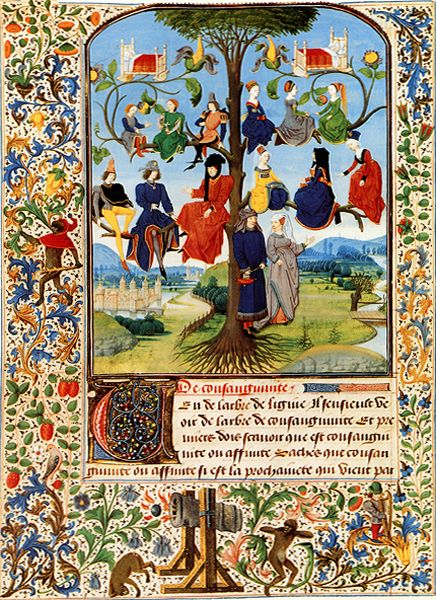
File:Consanguinitet.jpgThe last in the series on genetic testing is up at Family Tree Firsts.  You can read it here.

Still pretty bummed about the results, it was very promising.  However, like I said in the article, the results are out there we just have to wait for someone in a branch of our line to take the tests themselves.  My parents were gone for the last 2 weeks so I just told them yesterday about the results.  Dad was disappointed too, and told me that this seems like a lot of headache for me... why did I want to go through all the anyway?  Well, you see, now it is a challenge.  Sometimes, I just can't back away from a challenge!

At this point I have to go back to research the old fashioned way.  Keep plodding along trying to put the pieces of the puzzle together and find out who Charles's parents were and where in Virginia he came from.  There are many Combs families in Virginia, I just have to figure out which one he fits into.  Sometimes I wish a Combs cousin would fall out of the ether and give me that little piece of information that I need.  Hey, I can wish!  It has happened with a couple other lines...

*Image from wikicommons: L'arbre de consanguinité, Somme rurale de Jean Boutillier

Wednesday, June 6, 2012

Part 2 of Genetic Geneaolgy Post

Part 2 is up today, and you can read it here.

I wanted to go through what all the letters and numbers mean on the tests to make sure people understood what they were looking at if they ever went through this.  There are a lot more letters, numbers, and jargon that goes into the testing process, but I am not quite ready to jump into all that yet.  Particularly if I don't have to right now.  Easing into the pool one toe at a time so to speak.

The archives that I have fond online have been very helpful, but I have not broken down any walls yet.  This will end with me making a trek to Surry County eventually.  Visiting the archives where I can see the records and not just the on-line index appears to be the next course of action.

Currently I am finishing up the post for next week.  I have the rest of the data finally and I am crunching the numbers.  No give aways, but you'll want to tune in to see if I have a match or not!

*Image of precipitated DNA from wikicommons: Deutsch: DNA im Naturkundemuseum in Berlin