Search This Blog

Translate

Thursday, October 25, 2012

Crazy Ideas are my life

Today I had a completely crazy, yet horribly exciting, idea pop into my head. The next time I go home I want to map out a couple of the family cemeteries. Goofy right? But totally worth every minute of the pain it would be to do it!
 
I was searching between trees online trying to figure out ancestor relations between me and a couple other possible new cousins when it hit me. Over 1/2 of my Indiana ancestors are in 5 cemeteries. I know 5 may seem like a lot, but the area in Indiana I am looking at has nearly 200 that I know of, so 5 is really good in my book.
 
The ability to look at a map (with pictures maybe) and see how the families are laid out in the cemeteries would be great. If you can't tell, I am a very visual person. I have to see it, draw it myself usually, and then look it over in my head. That is the best way I learn. Write, draw, remember.
 
Maybe I can experiment with this idea on one of the smaller local cemeteries in my area of Virginia. See how I can make it more efficient before I go home... whenever that maybe.
 
Has anyone out there ever done anything like this?  Have any suggestions or tips? 
 
photo credit: Steve took it via photopin cc

Wednesday, October 24, 2012

Week 43 of Abundant Genealogy

Week 43: Memorable Genealogy Moment. Think back to when you first started researching your family history. Is there a memorable early genealogy moment that stands out in your mind? Describe this event or discovery and how it impacted your research going forward.

Seeing is it wasn’t all that long ago, this should be easy huh?  Thing is, it has been such a whirlwind of experiences that, to be honest, it is all really blurring together.  I feel your heart breaking for my dilemma.  So I thought, and thought, and then the one lasting lesson hit me.  The one I learned in my first few weeks.

The biggest discovery, that impacted all future research, was when I realized that not all trees online we were well researched.  To be honest, I was really naive enough to figure that if someone published it they actually went through the effort of verifying it.  Even if they had to go back and admit they were wrong, there was some sort of logical chain of events that brought them to the conclusions they published. 

This is one of the reasons that I made my Ancestry tree private.  Really, I use it more as a sounding board and put all my leads, ideas, clues, etc. there.  Yeah, I know, I could have multiple trees on my computer; a working tree and a published tree.  However, I know myself well enough to know that right now there was no way I could keep 2 trees going.  Even if it meant I wouldn’t be fed to a tank of piranhas it would be one of those things that would drive me crazy.  Still learning here folks, learning quickly, but still behind the curve on a few things.  Adding one more to-do on my list would make my mind explode.

That is why I love that people contact me when they want to know stuff from Ancestry.  Those who are interested will take the time to ask.  If you find an ancestor on it and want to correspond I am more than happy to do so.  I didn’t want people to just blindly copy and paste (like I had seen on so many repeating misinformation and errors) without talking to me.  Tell me which ancestor you want to know about and I will give it to you, with all my caveats laid out for you to peruse as well.

photo credit: Auntie P via photopin cc

Monday, October 22, 2012

Newspaper tells of car accident

I have bitten the bullet and jumped into the world of online historic newspapers.  Granted, I have found bits and pieces of information here and there thanks to Google from newspapers.  However, I had never jumped head first into the pool.  Oh noes…. This could be really bad.

This morning, while drinking my tea, I found an article telling about the car accident that ended my uncle's life on a rain soaked road, at 18, in 1959.  I have also found articles on my grandfather when he was running for the Indiana State House of Representatives.  Goodness knows what else I will find over the next few days, weeks, or months! 

It has been very fascinating to say the least.  I have to admit I was a bit disgusted at the 49 cents per pound for a roast in the 1964 newspaper I was looking at.  Mumble, grumble…..

 
Page 26, Anderson Herald Bulletin, November 14 1959

Three Added to Death Toll

United Press International

Three more traffic fatalities, all of them on the rain-drenched roads, sent the Indiana total moving steadily upward today as another weekend opened.

Two of the accidents occurred after the weekend count began at 6 p.m. Friday.  The other occurred a short time before the count began.

One of the victims was the son of an Indiana Legislator.  Another was killed trying to miss a dog in the highway.  The third was an old man in dark clothing who wandered into a busy highway in the evening gloom.

John Combs, 18, Washington, was killed early this morning when his car skidded off U.S. 50, hit a culvert and rolled over near Washington.  Combs was the son of Paul E. Combs (R-Washington).  Charles Shake, 20, Washington, who was riding with Combs, was taken to Daviess County Hospital with a back fracture and other injuries.

George Beatty, 81, near Columbus, was killed Friday night when he was hit by a car driven by Robert McKain, 35, Columbus, on U.S. 31.  Authorities said he fell or stumbled into the path of the car.

John Rue Mercer, 63, Indianapolis livestock buyer, was killed late Friday when his car collided with another vehicle as he swerved to miss a dog in U.S. 421 east of Whitestown.

State Police said the car skidded and struck a car driven by Harold Duckworth, 37, Frankfort.  Mercer was thrown to the pavement and died at the scene.  Duckworth was treated for a back injury at Clinton County Hospital in Frankfort.

 
photo credit: ShironekoEuro via photopin cc

Friday, October 19, 2012

Week 42 of Abundant Genealogy

Harry Coad:  picture from his Civil War
Pension file located at NARA
Week 42: Biggest Genealogy Accomplishment. What do you feel is your biggest genealogy accomplishment? What were the steps you took to get there, and what was the end result?

My biggest accomplishment was figuring out the true story of my husband’s 3rd great grandfather, Harry Coad aka Henry Thompson.  This mystery had nagged at me since I heard it and once I saw the opportunity to track it down I jumped on it. 

My husband had told me the story several times over the years, as he remembered it from his grandmother.  After I started delving into our family histories I cornered my father-in-law and asked him what he remembered of the story.  Tracking down the hints, clues, and leads on-line lead me to the National Archives in D.C. and to the amazing story of this man.

You can read about my discoveries here on this blog as well as on the Family Tree Firsts blog at Family Tree University.  Just click on “Coad” or “Family Tree Firsts” under the tags section to see what I have to say.


Thursday, October 18, 2012

Next FTF post is up: death in the family

Mrs. Nellie Grant Sartoris with baby.
This baby–Princess Cantacuzene–
unveiled the Grant Memorial in the Mall,
Wash. DC in April 1922.
This baby’s daughter, “Princess Ida,”
assisted her mother in the unveiling.
Courtesy of the Library of Congress
Prints and Photographs Division.
My next post at Family Tree Firsts is up, and you can read it here.

I wanted to do a different type post for Family History Month, and in my mind merging 2 observances that are related was the perfect way to do that.  Remembering all of your family, even the littlest ones who were never known, seemed appropriate.

My story is very personal, but like I said in my post, I needed to include our daughter and my medical history in my tree.  Hopefully, one day, someone will understand the causes of my medical problems and will be able to act in time to save the lives of a child and mother.

Briefly, I suffer from an unknown blood clotting disorder.  Unknown in that medical science doesn’t know what it is, I don’t test positive for any of the known diseases, but I present when pregnant like I have a clotting disorder.  Makes trying to treat you difficult to say the least.  We are lucky, and thankful, to have the 2 wonderful children that we do have.  This is all we will have, and we have come to terms with that since there are so many out there who don’t even have the chance to have one.

With my first child I fell extremely ill at 25 weeks and thought it was the flu.  No, it wasn’t.    I had developed HELLP Syndrome, class I under the old classification system, and was lucky that I made it through.  In the US the maternal mortality rate from HELLP Syndrome is roughly 1%, but the infant rate is 10-60% depending on gestational age and other factors.  You can read more at the Preeclampsia Foundation.

We decided to try again, and while I didn’t get as sick there were still complications.   After the stillbirth of our daughter we went about with all the paperwork that comes with a death.  I remember sitting on my bed when we got home and looking at the death certificate.  I thought to myself that this was unusual wasn’t it?  Was she really born?  Some didn’t think so, some did, some wanted me to stop dwelling and get on with my life.  But here I had this piece of paper from the government, so it did happen.

I wanted to write about it because these certificates can be useful for future researchers.  In 2003 the CDC redid their requirements for death and birth certificates which included more information and provisions for fetal death.  You can see their standards here. 

Mine is a treasure trove of genealogical information for future researchers.  It lists:
·         Name of fetus, sex, date of delivery, facility, city, county, and state
·         Complete name of mother, date of birth, state born, current address
·         Complete name of father, date of birth, and state born
·         Cause of death
·         Age of gestation, weight, and length
·         Doctors information
·         Burial information and funeral home
·         Education level of parents, occupation, race, number of prenatal visits, history of other pregnancies, and if parents are married

So much to learn from one piece of paper that is tucked away.

But that is not all.  In the last decade more and more states are now issuing Certificates of Birth Resulting in Stillbirth.  You can read this New York Times article on it from May 22, 2007.  Another piece of genealogical information to add to you list.


Wednesday, October 17, 2012

Fairfax County Genealogical Society Fall Fair

I just learned, today, that there is a one day genealogy fair not far from me.  How did I miss this?  Trying to figure out if I can make it up there to attend this event.  If you are in the area you should too.  It sounds amazing!  Early registration ends TOMORROW 10/18!!


Fairfax Genealogical Society
invites you to their
9th Annual Fall Fair: Federal Records with Claire Bettag

Date:
Saturday, October 27, 2012
9:00 AM to 3:00 PM (please arrive before 9:00 AM)

Location:
Dunn Loring Volunteer Fire Department
2148 Gallows Road
Dunn Loring, VA 22027

Register online at http://fxgsfallfair2012.eventbrite.com or download the registration form

Featured Speaker: Claire Bettag, CG, FUGA is a certified professional genealogist based in Washington D.C. whose research focuses on French and Acadian families of Louisiana. She conducts research in Louisiana, Europe, and Washington. She teaches at the National Institute on Genealogical Research (NIGR), the Salt Lake Institute of Genealogy (SLIG), the Genealogy and Research Institute of Pittsburgh (GRIP), and the Institute of Genealogy and Historical Research at Samford University (IGHR).

A contributing author to Professional Genealogy, she has also published articles in the National Genealogical Society Quarterly, APG Quarterly, and other genealogical publications. She has served as the director of NIGR and a ProGen mentor, and on the boards of NGS, APG, and BCG. Currently she is on the editorial board of the National Genealogical Society Quarterly and volunteers at the National Archives. Her M.A. in French is from Columbia University; she has studied in France as a Fulbright fellow, and in Quebec, Spain, and Mexico.

Lectures:

"FEDERAL LAND RECORDS"
From 1789 to the late nineteenth century, the United States acquired land and added it to the public domain. The federal government then surveyed the land and disposed of it, creating federal land records in the process. Today the National Archives holds land records for the thirty public land states whose lands were part of the U.S. public domain. These records are valuable for locating families and individuals at a specific date and documenting family land holdings. They may also provide additional valuable family information. The presentation discusses land entry papers primarily, with brief mention of surrendered bounty-land warrants.

"THE CONGRESSIONAL SERIAL SET"
The U.S. Congressional Serial Set, published by the U.S. Government Printing Office, is part of a vast collection of published public documents popularly known as "Gov Docs" (government documents). The Serial Set ranks among the most valuable — and most underused — genealogical resources for family historians. Containing records of the U.S. Congress, executive agencies, independent commissions, and other entities, it provides a wealth of information, often untapped by researchers. The presentation discusses Serial Set contents and access, with numerous examples.

"LIBRARY OF CONGRESS RESOURCES: MANUSCRIPTS DIVISION"
The Manuscript Division of the Library of Congress houses more than eleven thousand collections containing about fifty million items. Beyond the Library's Local History and Genealogy Collection, this is one of its best potential sources for family historians. Yet, researchers rarely mine its riches. Among its holdings are the private papers of American political, cultural, and scientific figures: reformers, writers, inventors, scientists, historians, anthropologists, celebrities, journalists, artists, architects, and more; documents from foreign countries related to American colonial history, often containing information about individuals and families; and much more.

 
Registration includes all lectures, lunch (see below), access to the vendors, and an electronic syllabus. A printed copy of the syllabus is available for $5.00.

A boxed lunch (sandwich, side, and drink) is included for registrations received by Thursday, October 18. Registrations after this date include lunch only if extras are available.

Regular registrations must be received by October 18. All registrations received after October 18 will be charged the late registration fee. A printed syllabus is included for late/walk-in registrations. Registrations postmarked by October 17 but received after the 18th will receive the regular registration fee but will only include lunch if extras are available. Register early!

Parking is available at the fire station as well as on the street. There is also overflow parking in the school parking lot next door.

Check-in/registration begins at 8:00 AM.

Vendors open at 8:00 AM.

 
photo credit: Simon Adriaensen via photopin cc

Book Review and Contest Winner

I have discovered another podcast that I LOVE, oh yeah all caps LOVE.  It is Fieldstone Common by Marian Pierre-Louis.  This show covers New England history and genealogy through 1 hour interviews with people who have knowledge of this area.  So far there have been curators, archivists, authors, and genealogists on her show and we are only a little over a month in.

Her show is at 1pm EST Thursdays on Blogtalk Radio.  Until 2 weeks ago I had been unable to listen to it live as I was out running errands or at other appointments on those days.  I was so excited that I would actually be home for one!  When the time came to listen I turned my computer up all the way and sat down to do some work at my kitchen table.

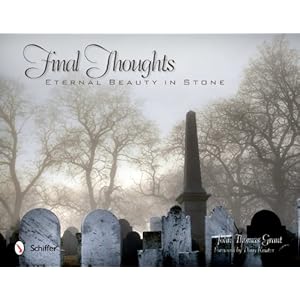
That particular show was an interview with John Thomas Grant on his book Final Thoughts: Eternal Beauty in Stone.  Until this show I was unfamiliar with his work, but I love taking pictures; much to the amusement of my family.  My husband sighs when we are out and tells the boys to pause while "mom is being artistic again."  While I am not a great photographer, I have admiration for those who are and enjoy looking at books of pictures to study their techniques.   
 
Mr. Grant is a cemetery photographer and listening to him tell his stories of uncovering headstones, techniques to bring the marble to life, and the reasons he does what he does held me in rapt attention.  I decided half way through the program I was going to call in for the chance at winning the free book; I had to see it!

The time came to call, and imagine my surprise when I found myself on the radio!  I wasn't sure if she was talking to me at first, but decided since no one else answered I must be live... on the air... gulp.  This is when I discovered my voice goes up in pitch when I get excited and I think I sound like some sort of spunky elf on the radio.  There is not future as a regular podcaster for me!  Well, not unless I can bring my voice down an octave that is. 

Marian mailed me my copy and I received it late last week.  It is amazing.  He is a phenomenal photographer and there are times where he makes them so life like I am waiting for the statues to turn around!  Each page also contains words from the headstones he has photographed, and it adds to the flavor and ambiance of the book.  I recommend it to anyone who is interested in photography, graveyards, or beautiful moments. 

Fieldstone Common is available through iTunes as well as the website.  Go check it out!